Trimming Your Dog's Nails Safely
by admin in Pet Care Basics 242 - Last Update November 30, 2025
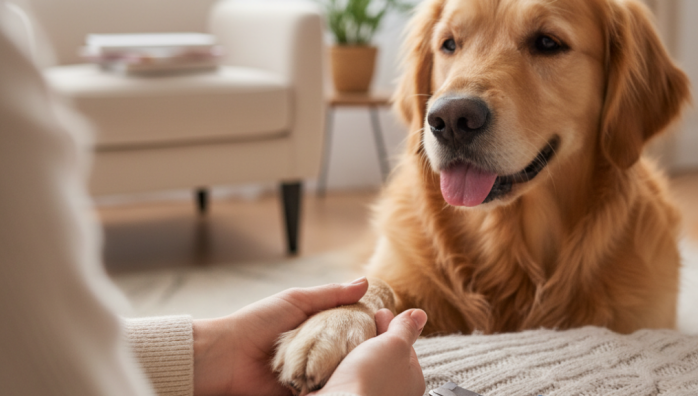
I still remember the first time I tried to trim my dog\'s nails. My hands were shaking, he was squirming, and I was absolutely terrified of hurting him. That little \'click-clack\' sound on our hardwood floors was a constant source of guilt. It took a lot of trial, error, and some patient advice from my vet, but over the years, I\'ve developed a routine that\'s calm, safe, and stress-free for both of us. Honestly, it\'s now a quiet bonding moment rather than a battle.
Choosing the right tools for the job
The wall of options at the pet store can be overwhelming. For years, I used the guillotine-style clippers, but I found they dulled quickly and could sometimes crush the nail rather than cut it cleanly. I\'ve since switched to the scissor-style (often called \'plier-style\') clippers. I find they give me much more control and a cleaner cut. For dogs with thick, tough nails, a nail grinder can be a fantastic, albeit noisy, option. The absolute non-negotiable tool in my kit, though, is styptic powder. It\'s a lifesaver if you accidentally trim a bit too far.
Understanding your dog\'s nail anatomy
The source of all our fear is that dreaded \'quick\'—the bundle of nerves and blood vessels inside the nail. On dogs with white or light-colored nails, you can often see the pinkish quick right through the nail, which makes things much easier. The real challenge, and one I faced with my previous dog, is black nails. You can\'t see the quick at all. The secret I learned is to look at the cut surface of the nail as you trim. You\'ll see the outer nail, then a whitish/grey pulpy ring, and just before the quick, a small black dot will appear in the center. That\'s your stop sign!
My step-by-step process for a stress-free trim
This is the routine that turned things around for me. It\'s not about speed; it\'s about patience and trust.
- Set a calm stage. I never trim nails when I\'m rushed or stressed, as my dog picks up on it immediately. We do it in a quiet room, often after a long walk when he\'s a bit tired.
- Handle paws often. I make a habit of gently touching and holding my dog\'s paws throughout the week, completely unrelated to nail trimming. I give him a treat for letting me. This removes the negative association of \'paw touch = clippers\'.
- Take tiny slivers. This is the most important part. I don\'t try to take the whole tip off in one go. I trim just the very end, like slicing a tiny piece off a salami. I make several tiny cuts instead of one big one.
- Reward generously. After each paw, or even after a single nail if he\'s being particularly good, he gets a high-value treat. This builds a positive association.
What if i cut the quick?
First, don\'t panic. It has happened to me, and it happens to professional groomers, too. Your dog will likely yelp and pull back. Stay calm, speak in a reassuring voice, and apply a pinch of styptic powder to the nail tip. The bleeding will stop very quickly. Give your pup a treat and lots of praise, and then call it a day. Don\'t force them to continue. It\'s better to end on a relatively positive note and try again another day.
Ultimately, keeping your dog\'s nails at a healthy length is crucial for their posture and joint health. If you\'re truly uncomfortable or your dog has extreme anxiety, there is absolutely no shame in seeking help from a professional groomer or your vet\'s office. This is just the method that worked for my dogs, but every pup is different, and I always suggest chatting with your vet for personalized advice.