Safe At-Home Nail Trimming for Pets
by admin in Pet Care Basics 127 - Last Update December 1, 2025
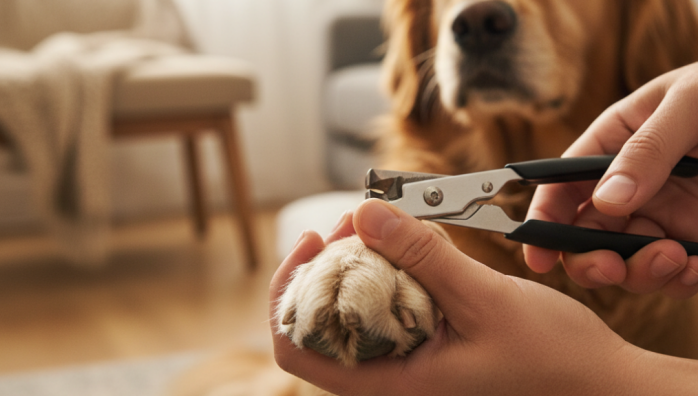
I still remember the first time I tried to trim my dog\'s nails at home. My hands were shaking, he was squirming, and I was absolutely terrified of hurting him. That distinct \'click-clack\' sound on our hardwood floors was a constant reminder of my failure. It took me a long time, a lot of patience, and a few mishaps to learn that it doesn\'t have to be a stressful ordeal for either of us. Now, it\'s a calm, routine part of our care, and I want to share what I\'ve learned to help you feel confident, too.
Why regular nail trimming is so important
Before we get into the \'how,\' it\'s crucial to understand the \'why.\' Overgrown nails aren\'t just a cosmetic issue. They can force a pet\'s toes into an unnatural position, causing pain and pressure on the toe joints. Over time, this can lead to issues with their gait, affect the alignment of their legs, and even contribute to arthritis. For cats, long nails can get caught in furniture and carpets, leading to painful injuries. For me, knowing this transformed nail trimming from a chore I dreaded into an essential act of care.
Gathering the right tools for the job
Having the right equipment made a world of difference for me. You don\'t need a lot, but what you have should be high quality. Here’s my go-to kit:
- High-Quality Clippers: There are two main styles: the scissor-type (which I prefer for cats and small dogs) and the guillotine-style. The key is that they must be sharp. Dull clippers can crush the nail instead of cutting it, which is painful.
- A Nail Grinder (Optional): Some pets, and owners, prefer a grinder. It files the nail down gradually, which can feel less intimidating. It\'s great for smoothing edges after clipping, too.
- Styptic Powder: This is non-negotiable. If you accidentally cut the quick (the blood vessel inside the nail), this powder will stop the bleeding quickly. I keep it open and next to me every single time, just in case.
- Lots of High-Value Treats: Make this a positive experience! I use tiny pieces of cheese or chicken that my pet absolutely loves and only gets during our \'pawdicure\' sessions.
My step-by-step guide to a calm trim
The secret isn\'t about speed; it\'s about patience and creating a positive association. Rushing is your enemy.
Step 1: create a calm environment
I choose a quiet time when the house is calm and my pet is relaxed, often after a good walk or playtime. I sit on the floor in a well-lit room, which feels less clinical than a table. I let my pet sniff the tools and give them a treat just for being near them.
Step 2: identify the quick
This was my biggest fear. The quick contains nerves and blood vessels. On pets with light-colored nails, it\'s the pink part you can easily see. On dark nails, it\'s impossible to see from the outside. For my dog with black nails, I learned to look at the cut surface of the nail. As you get closer to the quick, you\'ll see a small, dark circle appear in the center. That\'s your signal to stop.
Step 3: use the \'tiny snips\' method
I never try to take off a large chunk of nail at once. I take off just the very tip of the nail. Then I take another tiny sliver. I continue this process until I see that small circle I mentioned, or until I\'m satisfied with the length. This is the safest way to avoid the quick on dark nails.
Step 4: what to do if you make a mistake
It happens to everyone, even pros. The first time I accidentally nicked the quick, I panicked, which made my dog panic. I\'ve learned that the key is to stay calm. Don\'t make a big deal out of it. Quietly take a pinch of styptic powder, press it firmly onto the nail tip for about 30 seconds, and it will stop the bleeding. Give your pet a super high-value treat, lots of praise, and then stop for the day. Don\'t push it.
Final thoughts on making it a positive routine
My biggest takeaway is this: it\'s better to trim one nail a day for a week than to fight through all four paws in one stressful session. The goal is to build trust. End every session on a positive note, even if you only managed to trim one nail. Over time, your pet will learn that this is a calm, predictable, and even rewarding experience. And remember, this is just my personal experience. I always suggest discussing your pet\'s specific needs with your veterinarian or a professional groomer, especially if your pet shows extreme fear or aggression.