Trimming Dog Nails At Home
by admin in Pet Care Basics 178 - Last Update December 5, 2025
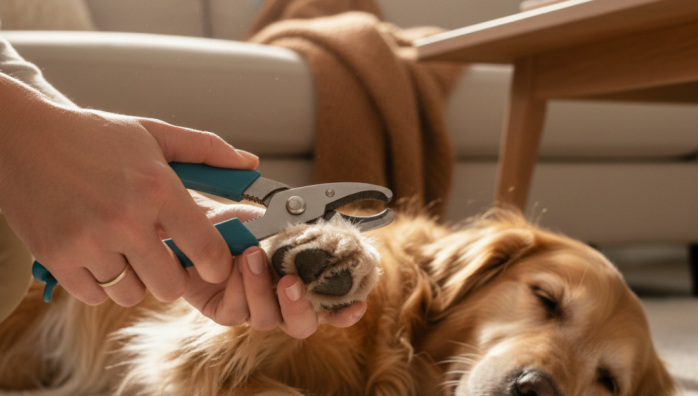
I\'ll be honest, for years, the thought of trimming my dog\'s nails sent a shiver down my spine. The fear of cutting the quick and hurting my best friend was paralyzing. I’d put it off until I heard that dreaded \'click-clack\' on the hardwood floors, a sound that screamed, \'You\'re overdue!\' After a few stressful and expensive trips to the groomer for a simple trim, I decided I had to master this myself. It wasn\'t easy at first, but over time, I developed a calm, confident routine that works for both of us, and I want to share what I\'ve learned with you.
Why you can\'t ignore long nails
Before we get into the \'how,\' let\'s talk about the \'why.\' This isn\'t just about aesthetics or saving your floors. Overly long nails can cause real problems for a dog. They force the paw into an unnatural position, which can lead to pain, pressure on the joints, and even arthritis over time. The nails can also split or get snagged, which is incredibly painful. Seeing it this way shifted my perspective from a dreaded chore to an essential part of my dog\'s wellness care.
Choosing your weapon: clippers vs. grinders
You have two main choices: guillotine or scissor-style clippers, or an electric nail grinder. I\'ve used both extensively.
- Clippers: They\'re quick and quiet. I started with scissor-style clippers because they felt more robust. The key is to make sure they are incredibly sharp. A dull blade will crush the nail instead of cutting it, which is painful and can cause splitting.
- Grinders: A grinder was a game-changer for my more anxious dog. The noise and vibration can take some getting used to, but it gives you incredible control. You can smooth the nail and get it very short by taking off tiny layers at a time, which greatly reduces the risk of hitting the quick.
My advice? Have both on hand. I often use the clippers to take off the main tip and then the grinder to smooth the edges and get a little closer.
My step-by-step guide to a calm trim
Success is all about preparation and patience. Don\'t plan to do this five minutes before you have to leave the house. Pick a time when you and your dog are both relaxed.
1. Get your station ready
Before you even get your dog, lay everything out. You\'ll need your clippers or grinder, some high-value treats (think tiny pieces of cheese or chicken, not regular kibble), and most importantly, some styptic powder. Styptic powder stops bleeding instantly if you do nick the quick. Having it within arm\'s reach will make you feel ten times more confident.
2. Finding the quick (the scary part)
The quick is the blood vessel and nerve that runs into the nail. On dogs with white nails, it\'s easy to see as a pinkish area. On black nails, it\'s invisible from the outside. The trick I learned for black nails is to look at the cut surface of the nail. As you snip off tiny slivers, you\'ll see a white or grayish oval appear in the center. As you get closer to the quick, this oval will turn into a black dot. When you see that black dot, stop! You\'re as close as you can safely go.
3. The actual trim
Hold your dog’s paw firmly but gently. Don\'t squeeze. Isolate one nail. If using clippers, take off just a tiny sliver from the tip. If you\'re nervous, it\'s far better to take off too little than too much. You can always take off more. Do one nail, then give a treat and praise. For the first few sessions, maybe you only do one paw. That\'s okay! The goal is to build a positive association.
4. If you hit the quick (don\'t panic!)
It has happened to me, and it will probably happen to you at some point. It\'s okay. Your dog will yelp, and there will be some blood, but it\'s not a catastrophe. Stay calm. Take a pinch of styptic powder and press it firmly onto the nail tip for about 30 seconds. The bleeding will stop. Give your dog lots of comfort and a super high-value treat, and then end the session for the day. Trying to push through will only create a negative memory.
Ultimately, trimming my dog’s nails at home has become a bonding experience. It’s a moment of trust between us. It took time and patience, but now it\'s just another part of our routine. If you\'re struggling, remember to start slow, stay positive, and don\'t be afraid to ask your vet or a professional groomer for an in-person tutorial. Your confidence will grow, and your dog will thank you for it.