How to Trim Your Pet's Nails Safely
by admin in Pet Care Basics 180 - Last Update December 6, 2025
I used to dread nail trimming day. Honestly, the mere sight of the clippers would send my first dog, a sweet but anxious beagle, scurrying under the bed. It felt like a wrestling match I was destined to lose, and I was terrified of hurting him. It took me years of trial, error, and a lot of patience to turn this stressful chore into a calm, manageable routine. If you\'re feeling that same anxiety, I want to share what I\'ve learned so you can feel confident and keep your furry friend comfortable.
Why regular nail trims are so important
Before we get into the \'how,\' it\'s crucial to understand the \'why.\' I learned this the hard way when my older dog started having issues with his gait. Overly long nails can be more than just a nuisance; they can affect your pet’s posture and even lead to pain or joint problems. They force the paw into an unnatural position, and on slick floors, they can cause your pet to slip and injure themselves. Keeping them trimmed is a fundamental part of their health and wellness.
Gathering the right tools for the job
Having the right equipment made a world of difference for me. You don\'t need a lot, but what you have should be high quality and appropriate for your pet.
Clippers or a grinder?
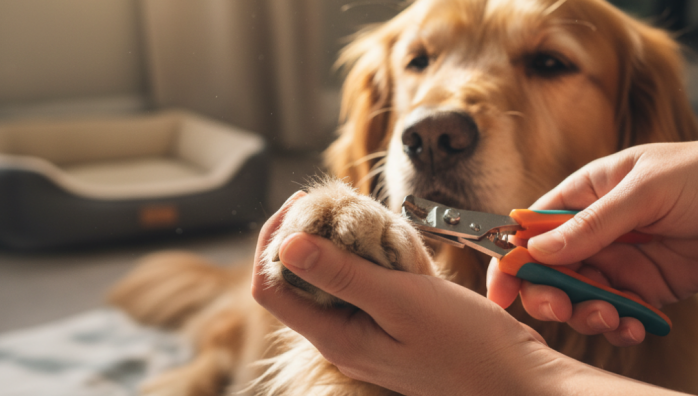
There are two main types of clippers I\'ve used: guillotine style and scissor (or plier) style. For my cats and smaller dogs, the guillotine clippers worked well. But for my current dog\'s thicker nails, I find the scissor-style clippers give me more control and a cleaner cut. Another fantastic option is a nail grinder. For one of my more sound-sensitive rescues, the \'snap\' of the clippers was the scariest part. A low-noise grinder was a game-changer, allowing me to gently file his nails down. The key is to introduce it slowly and with lots of positive reinforcement.
Don\'t forget the styptic powder
Trust me on this: have styptic powder or a styptic pencil on hand before you even start. Even the most experienced of us can accidentally nick the \'quick\' (the blood vessel in the nail). It happens. Being prepared to stop the bleeding quickly and painlessly will keep a minor incident from becoming a major drama. It\'s my number one, non-negotiable safety tool.
A step-by-step guide to a stress-free trim
My approach is all about creating a positive association. This isn\'t a task to be rushed. I always pick a time when my dog is calm and tired, like after a long walk.
- Get Comfortable: I sit on the floor in a quiet, well-lit room. This feels less intimidating than putting them up on a table. I let my dog settle next to me and give him a few minutes of praise and pets.
- Handle the Paws: Gently pick up one paw. Hold it firmly but not tightly. I make a habit of handling my pets\' paws regularly, even when not trimming, so they are used to the sensation.
- Identify the Quick: If your pet has light-colored nails, you can see the pink quick inside. Your goal is to trim the white part of the nail, stopping a few millimeters before the pink. For my dogs with black nails, this was the scariest part. The trick I learned is to trim just a tiny sliver off the end. Look at the cut surface; as you get closer to the quick, you\'ll see a small, dark, fleshy-looking circle appear. That\'s your sign to stop.
- Trim and Reward: Make a quick, decisive snip. I only do one or two nails at a time, followed by a high-value treat and lots of praise. Then I might let him go and we\'ll do another paw later. It doesn\'t have to be done all at once!
What to do if you cut the quick
First, don\'t panic. Your pet will feed off your energy. I\'ve done it, and my initial panic only made my dog more scared. Stay calm, speak in a reassuring voice, and immediately apply the styptic powder to the nail tip to stop the bleeding. Give your pet a favorite treat and end the session on that positive note. Don\'t try to force them to continue. The goal is building long-term trust, not getting every nail perfect in one go. Remember, this is a skill you and your pet learn together. Be patient with them, and with yourself. While these techniques have worked for all the pets I\'ve cared for, every animal is unique. I always recommend that if you\'re feeling nervous, have your vet or a professional groomer give you a hands-on demonstration first.