Safe Indoor Plants for Pets
by admin in Pet Care Basics 178 - Last Update December 5, 2025
I\'ll never forget the heart-stopping moment I walked in to find my new kitten, Leo, batting at and then chewing on the leaves of a beautiful Dieffenbachia I’d just been gifted. My stomach dropped. I knew that one was on the \'danger\' list. Thankfully, I got to him in time and a frantic call to the vet confirmed he was fine, but it was a wake-up call. For years now, I’ve made it my mission to create a home that’s a lush, green sanctuary but also a completely safe space for my furry family members. It\'s not about giving up on houseplants; it\'s about choosing the right ones.
Why choosing pet-safe plants is so important
It\'s easy to underestimate the curiosity of a bored cat or a teething puppy. Many of the most popular houseplants, like lilies, Sago Palms, and Pothos, can be severely toxic, causing everything from mild stomach upset to kidney failure or even death. As pet parents, it\'s our responsibility to eliminate those risks from their environment. I learned the hard way that a plant\'s beauty is never worth my pet\'s well-being. Creating a pet-safe home brings a peace of mind that is truly priceless.
My favorite non-toxic houseplants for a pet-friendly home
Over the years, I\'ve curated a collection of beautiful, resilient, and, most importantly, completely non-toxic plants. These are a few of my tried-and-true favorites that thrive indoors and won\'t cause panic if a curious paw or snout gets too close.
The spider plant (Chlorophytum comosum)
Honestly, this is the champion of pet-safe plants. It\'s incredibly resilient, great for beginner plant owners, and an amazing air purifier. My cats have always been fascinated by its dangly \'spiderettes\'. While it\'s non-toxic, I’ve found cats are drawn to it because it can have a mild, harmless hallucinogenic effect on them. I keep mine in a hanging basket just high enough so they can\'t turn it into a full-on salad bar, but I don\'t worry if they manage to nibble a leaf.
The prayer plant (Maranta leuconeura)
I adore the stunning, patterned leaves of the Prayer Plant. Watching its leaves fold up at night, as if in prayer, is such a peaceful ritual. It\'s completely safe for both cats and dogs and adds a gorgeous splash of color to any room. It does prefer higher humidity, so I keep mine in my bathroom, where my dog rarely bothers it.
The money tree (Pachira aquatica)
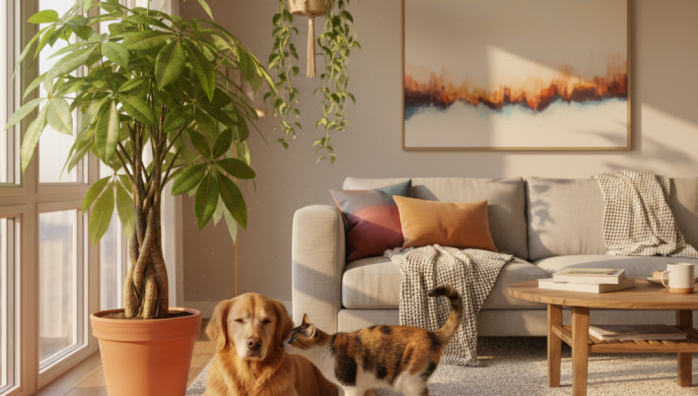
Despite its association with luck and fortune, the best thing about this plant for me is that it\'s non-toxic to my pets. Its braided trunk is a beautiful feature, and it’s surprisingly easy to care for. I\'ve found it\'s sturdy enough to withstand an occasional bump from my clumsy Golden Retriever, and he\'s never shown any interest in chewing on its leaves.
The boston fern (Nephrolepis exaltata)
If you want to add a touch of lush, feathery greenery, the Boston Fern is a perfect choice. They look fantastic in hanging planters or on a high shelf, creating a cascade of green. They are completely safe for pets and do a great job of improving air quality. My experience is they do need consistent moisture, so I’ve learned not to let them dry out.
A quick note on supervision
It\'s important to remember that even \'non-toxic\' doesn\'t mean \'edible.\' A pet eating a large quantity of any plant can still lead to an upset stomach, vomiting, or diarrhea. I always encourage enrichment and providing plenty of appropriate toys to keep my pets from getting bored and turning to my plants for entertainment. A little supervision goes a long way.
What to do if you suspect poisoning
If you ever suspect your pet has ingested a toxic plant, don\'t wait. Contact your veterinarian, a local emergency animal hospital, or a pet poison control hotline immediately. It\'s always better to be safe than sorry. This is just my personal advice based on my own experiences, and I always, always recommend chatting with your vet to make the best decisions for your specific pet\'s health and safety.