Identifying Safe Houseplants for Cats
by admin in Pet Care Basics 133 - Last Update December 6, 2025
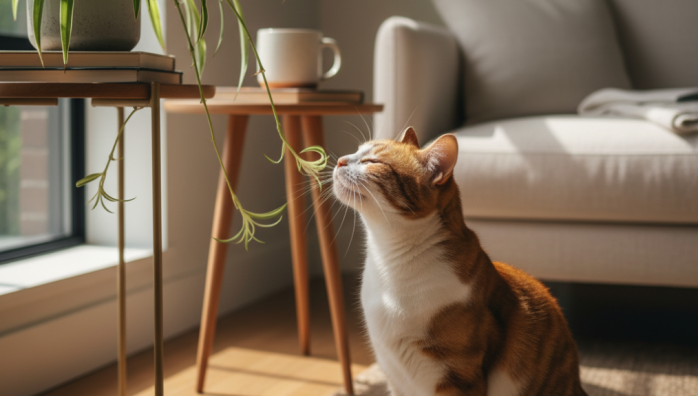
When I first brought my rescue cat, Leo, home, I was overjoyed. But then a wave of panic hit me as I looked around my little indoor jungle. Are my houseplants safe for him? I spent hours frantically searching online, cross-referencing lists, and feeling completely overwhelmed. It took a while, but I eventually figured out how to create a green space that was beautiful for me and, most importantly, completely safe for my curious feline friend. It was a huge weight off my shoulders, and I want to share what I learned along the way.
Why our cats are drawn to houseplants
Before I started banning plants, I wanted to understand why Leo was so interested in them in the first place. Sometimes it\'s simple curiosity or boredom. For other cats, chewing on greens can be an instinctual behavior, perhaps to help with digestion or just because the texture is interesting. Realizing it wasn\'t a \'bad\' behavior, just a natural one, helped me approach the problem with more patience and a focus on providing safe alternatives rather than just saying \'no\'.
My personal list of cat-safe favorites
Creating a pet-friendly plant collection has been a rewarding journey. These are a few of my tried-and-true favorites that are non-toxic to cats and have thrived in my home.
- Spider Plant (Chlorophytum comosum): This is the classic! It\'s resilient, great for air purifying, and completely safe. Leo loves to bat at the little \'spiderettes\' that hang down, so it doubles as a toy.
- Boston Fern (Nephrolepis exaltata): I love the lush, feathery look of these. They bring a real \'jungle\' vibe to a room. They do like humidity, so I keep mine in the bathroom, far from Leo\'s main hangout spots, just so he doesn\'t shred the delicate fronds.
- Calathea (Prayer Plant): The patterns on these leaves are stunning. Watching the leaves fold up at night is such a cool little quirk. They are completely non-toxic and add a beautiful splash of color.
- Haworthia (Zebra Plant): Not to be confused with the toxic Aphelandra squarrosa, this little succulent is a perfect, cat-safe alternative to an aloe plant. It\'s low-maintenance and looks great on a sunny windowsill.
A special note on growing cat grass
One of the best things I ever did was start growing a little pot of \'cat grass\' (usually oat, rye, or wheat grass). It gives Leo a plant that is his and his alone. He can chew on it to his heart\'s content, and it satisfies his craving for greens, making him much less likely to bother my other plants. It’s incredibly easy to grow from seed.
Plants i learned to keep out of my home
Learning what was safe was only half the battle. Identifying the common but highly toxic plants was just as crucial. Based on my research and conversations with my vet, these are plants I will never have in my home with a cat.
- Lilies (Lilium species): This is my number one warning. Every part of the lily plant is lethally toxic to cats, including the pollen. Even drinking the water from a vase of lilies can cause kidney failure. It\'s a risk I\'m simply not willing to take.
- Sago Palm (Cycas revoluta): Despite the name, it\'s not a true palm. It\'s a cycad, and it is extremely poisonous. The seeds are the most toxic part, but the entire plant is dangerous.
- Dieffenbachia (Dumb Cane): This popular houseplant contains crystals that cause intense oral irritation, swelling, and pain if ingested. It\'s a definite no-go for me.
A final word of caution from one pet parent to another
This list is based on my personal experience and research, but it\'s not exhaustive. The best rule I\'ve learned is: when in doubt, look it up. Before bringing any new plant home, I always double-check it against a trusted source like the ASPCA\'s plant list. And of course, this is just what has worked for me and my cat; I always recommend having a quick chat with your vet if you have any specific concerns about your pet\'s health and safety. Creating a safe home for them is the best gift we can give.