Best Pet-Safe Greens for Your Home
by admin in Pet Care Basics 94 - Last Update December 4, 2025
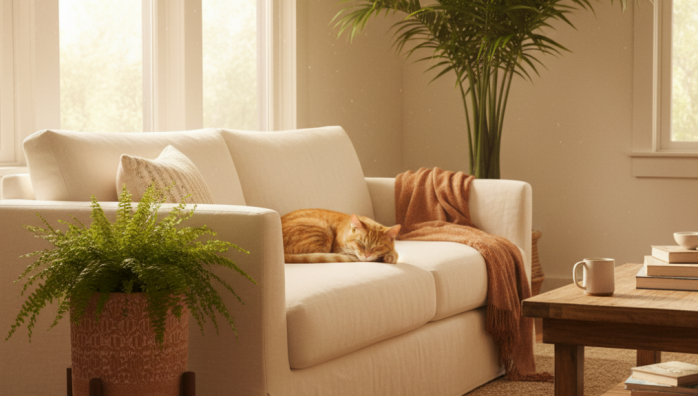
I\'ll never forget the moment I brought home a beautiful fiddle-leaf fig tree. I was so proud of it, until I saw my curious cat, Leo, batting at its leaves. A frantic search later, I realized it was toxic to him. The panic I felt was awful. That experience completely changed how I approach being both a plant lover and a pet parent. It\'s not about choosing one over the other; it\'s about creating a shared space that\'s safe and beautiful for everyone.
Why choosing pet-safe plants is a non-negotiable for me
For me, my pets\' safety is paramount. Many common and stunning houseplants, like lilies, sago palms, and oleander, can be incredibly dangerous, even fatal, if ingested by cats or dogs. The risk just isn\'t worth it. I learned that I could still have a lush, green home without the constant worry. It just required a bit more research and intentionality, which honestly, has made my plant collection even more special to me.
My absolute favorite pet-safe houseplants
Over the years, I\'ve curated a collection of plants that are not only gorgeous but also give me complete peace of mind. These are my tried-and-true favorites that have thrived in my home alongside my furry family.
The spider plant (Chlorophytum comosum)
This is the classic starter plant for a reason! It\'s incredibly resilient and forgiving, plus it produces little \'spiderettes\' that are fun to propagate. My cats love to bat at the dangly plantlets, and I don\'t have to worry when they do. It\'s a win-win.
The parlor palm (Chamaedorea elegans)
If you want a tropical vibe without the danger, the Parlor Palm is your answer. It\'s elegant, relatively low-maintenance, and adds a touch of lushness to any corner. I have one in my living room, and it\'s completely ignored by my dog, which is the highest praise I can give.
The prayer plant (Calathea)
I am obsessed with the stunning foliage of Calatheas. Their leaves, often with vibrant pink or white patterns, fold up at night as if in prayer. They require a bit more attention to humidity, but their beauty and pet-safe status make them well worth the effort in my book.
The boston fern (Nephrolepis exaltata)
There\'s something so timeless about a big, bushy Boston Fern. They love humidity, making them perfect for a bathroom, and their feathery fronds are completely non-toxic. They create an instant jungle-like feel that I just adore.
The haworthia (Zebra plant)
For succulent lovers, many common varieties are surprisingly toxic. That\'s why I turned to Haworthias. These small, striped succulents have the classic desert look without the risk of a Jade or Aloe plant. They\'re perfect for sunny windowsills where curious paws might wander.
A crucial note on \'non-toxic\' vs. \'safe to eat\'
Here’s something I had to learn: \'non-toxic\' doesn\'t mean a plant is a vegetable. Even safe plants can cause mild stomach upset, vomiting, or diarrhea if your pet decides to eat a significant amount of leaves. My goal is always to discourage plant-chewing altogether by providing plenty of enrichment and toys. These plant choices are my safety net, not a salad bar. Before bringing any new plant home, I still do a quick cross-reference with the ASPCA\'s official plant list—I highly recommend you do the same. And of course, this is all based on my personal experience; I always suggest having a chat with your trusted veterinarian if you have specific concerns.