Safe Indoor Plants for Cat Owners
by admin in Pet Care Basics 96 - Last Update December 6, 2025
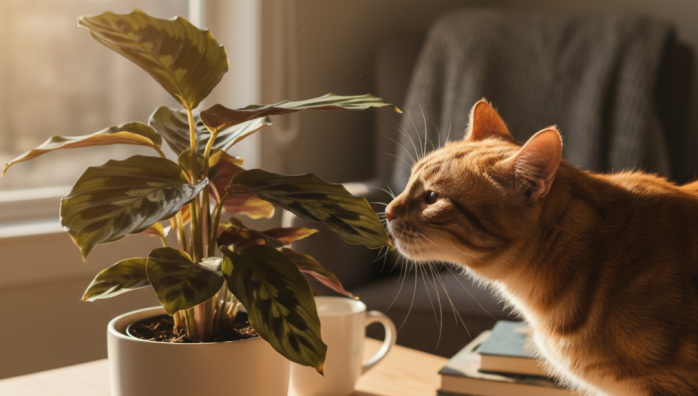
I\'ll never forget the moment of panic. I had just brought home a stunning Monstera deliciosa, its split leaves a perfect accent for my living room. Five minutes later, I walked in to find my cat, Willow, taking a curious nibble. My heart sank. A frantic search on my phone confirmed it: toxic. Thankfully, she was fine, but that scare taught me a crucial lesson. Being a plant parent and a cat parent requires careful planning, not just a good eye for design.
Over the years, I\'ve learned that you don\'t have to choose between a lush, green home and a safe cat. It’s about making smart choices. My home is now filled with beautiful plants that coexist peacefully with my feline companions, and I want to share some of my hard-won knowledge with you.
Why do cats chew on plants anyway?
Before we dive into the \'safe list\', it helps to understand why this happens. Honestly, I\'ve seen it all. Sometimes it\'s boredom, other times it’s pure curiosity. The texture of a crinkly leaf can be irresistible. For some cats, it can also be a way to get extra fiber or even soothe an upset stomach. Understanding the \'why\' helped me redirect the behavior, but it never eliminated it completely. That\'s why choosing non-toxic plants is the only foolproof safety net.
My tried-and-true cat-safe houseplants
Here are a few of my absolute favorites that have thrived in my home without ever causing a worry. They\'re beautiful, generally easy to care for, and most importantly, approved by my furry supervisors.
The resilient spider plant (Chlorophytum comosum)
This is the first pet-safe plant I ever bought. It\'s incredibly forgiving and its dangling \'pups\' are fantastic for propagation. Cats are often drawn to its long, grassy leaves, but the good news is it\'s completely non-toxic. I keep mine in a hanging basket, which adds a nice decorative touch and keeps it mostly out of reach, just in case.
The prayer plant family (Calathea and Maranta)
I am obsessed with the patterned leaves of Calatheas. They are breathtaking. Their leaves move up and down with the daily light cycle, which is fascinating to watch. They are a bit more demanding with humidity, but their beauty and non-toxic nature make them worth the extra effort. My Calathea Orbifolia is a real showstopper.
The classic parlor palm (Chamaedorea elegans)
If you want to add a tropical, airy feel to a room, look no further. The Parlor Palm is a slow-growing, low-maintenance palm that\'s perfectly safe for cats. It does well in lower light conditions, which is a huge bonus. I have one in a corner of my study, and it brings such a sense of calm to the space.
A quick word of caution
Even with non-toxic plants, it\'s a good idea to discourage excessive munching, as it can still cause mild stomach upset. More importantly, this list is based on my experience and research. Plant names can be tricky, so I always double-check any new purchase against a trusted source like the ASPCA\'s plant list. And if you ever suspect your cat has ingested any part of a plant you\'re unsure about, the best and only course of action is to call your veterinarian or a pet poison hotline immediately. It\'s always better to be safe than sorry.