Safe Indoor Plants for Curious Pets
by admin in Pet Care Basics 109 - Last Update December 3, 2025
I\'ll never forget the moment I walked into my living room to see my new kitten, Leo, batting at and then nibbling on the leaf of my beautiful dieffenbachia. My heart sank. I knew some plants were bad for pets, but I hadn\'t taken it seriously enough. A frantic call to the vet and a stressful afternoon later, Leo was fine, but I learned a valuable lesson: when you have pets, you can\'t just buy any plant that looks pretty. Your pet\'s safety has to come first.
Why choosing pet-safe plants is a non-negotiable for me
For me, creating a pet-friendly home isn\'t just about toys and comfy beds; it\'s about creating a safe environment. Many common houseplants contain toxins that can cause anything from mild stomach upset to severe, life-threatening reactions in cats and dogs. Our furry friends, especially when they\'re young and curious, explore the world with their mouths. It\'s our job to make sure their explorations don\'t land them in the emergency room. After my scare with Leo, I completely overhauled my indoor garden, and honestly, I\'ve never looked back. My home is still full of lush greenery, but now I have peace of mind.
My personal list of beautiful and safe houseplants
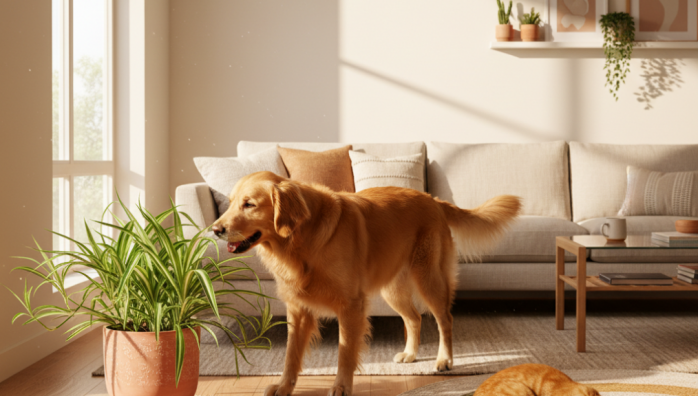
Over the years, I\'ve found some truly stunning plants that are completely non-toxic to my dog and cat. These are my tried-and-true favorites that are both gorgeous and worry-free.
The playful spider plant (chlorophytum comosum)
This is probably the MVP of pet-safe plants. It\'s incredibly resilient (I\'m not the best at remembering to water things!) and has these fun little \"spiderettes\" that dangle down. My cat loves to bat at them, and I don\'t have to worry if he gets a little nibble. They\'re also fantastic air purifiers.
The elegant boston fern (nephrolepis exaltata)
I keep one of these in my bathroom, and it thrives in the humidity. Its feathery, arching fronds add a touch of elegance, and it\'s completely safe for all my pets. It\'s a classic for a reason and brings a wonderful, lush feel to a room.
The fascinating prayer plant (calathea)
If you want a plant with personality, this is it. The leaves have beautiful, intricate patterns, and they fold up at night as if in prayer. It’s mesmerizing to watch. More importantly, it’s completely non-toxic, so when my dog gives it a curious sniff or lick, I can just smile.
The sturdy money tree (pachira aquatica)
I was so happy to learn this one was safe. With its braided trunk and vibrant green leaves, it makes a great statement piece. It’s very low-maintenance and brings a wonderful sense of calm and good fortune to my home office, without any risk to my snoozing companions.
A word of caution and final thoughts
Even with non-toxic plants, it\'s a good habit to discourage your pets from making them a regular snack. It\'s not great for the plant and can still sometimes cause mild stomach upset if they eat a large quantity. My biggest piece of advice is to always double-check a plant\'s toxicity on a reliable source, like the ASPCA\'s website, before you bring it home. It\'s a small step that provides immense peace of mind. While my experiences have helped me build a safe indoor jungle, I always suggest you chat with your vet if you have any specific concerns about your pet\'s health and environment. Happy planting!