Safe Indoor Plants for Curious Cats
by admin in Pet Care Basics 119 - Last Update November 27, 2025
I\'ll never forget the sheer panic I felt years ago. I had just brought home a stunning bouquet with lilies, and I turned around to see my cat, Milo, batting at a petal. My heart dropped. I knew lilies were incredibly toxic to cats, and it was a frantic rush to get them out of the house and call the vet. That scare completely changed how I approach being both a plant lover and a cat owner. It taught me that creating a beautiful green space and ensuring my feline friend\'s safety have to go hand-in-hand.
Why our cats are drawn to plants
Before I share my go-to list, I think it\'s helpful to understand *why* our cats seem so obsessed with our houseplants. It\'s not usually because they\'re hungry. For many cats, especially indoor ones, it\'s a mix of curiosity, boredom, and instinct. The rustling leaves can mimic prey, and chewing on fibrous material can sometimes help with digestion or hairballs. For my current cat, Luna, it\'s definitely about texture and play. Understanding this helped me provide better alternatives, like cat grass, to redirect her attention.
My personal list of cat-safe houseplants
Over the years, I\'ve curated a collection of plants that are not only beautiful but give me complete peace of mind. These are the ones I\'ve had the most success with, both in terms of keeping them alive and keeping my cat uninterested or safe if she does take a nibble.
The spider plant (Chlorophytum comosum)
This is the classic, and for good reason. It\'s incredibly resilient and its dangling \'spiderettes\' are a fantastic, non-toxic toy for a playful cat. Luna loves to bat at them. They are mildly hallucinogenic to cats, which might explain their attraction, but they are considered non-toxic. I just keep an eye on her to make sure she doesn\'t overdo it.
Calathea family (Prayer plants, Rattlesnake plants)
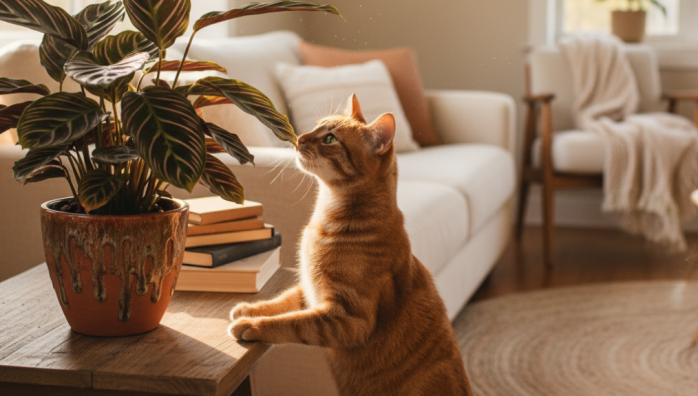
I adore Calatheas for their stunning, patterned foliage. The fact that their leaves move up and down with the daily light cycle is a source of endless fascination for my cat. They are completely non-toxic and add such a vibrant, tropical feel to a room.
Boston fern (Nephrolepis exaltata)
If you want that lush, jungle vibe, the Boston Fern is perfect. Its frilly, feathery fronds are fun for cats to interact with and are entirely safe. They do require a bit more humidity, but I find that misting them daily is a small price to pay for such a gorgeous, pet-friendly plant.
Money tree (Pachira aquatica)
Despite its name sometimes being associated with other, toxic plants, the Pachira aquatica is safe for cats and dogs. Its braided trunk is a beautiful feature, and I\'ve found it\'s quite hardy. I keep mine on a taller stand, which seems to deter my cat from trying to climb it, but I know she\'s safe if she ever chews a leaf.
A quick word of caution
It\'s important to remember that \'non-toxic\' doesn\'t mean \'edible\'. Even safe plants can cause mild stomach upset, vomiting, or diarrhea if your cat eats a large quantity. The goal is to create an environment where an accidental nibble isn\'t a cause for a vet emergency. I always recommend observing your own pet\'s behavior. And, of course, this is based on my own experience and research; it\'s always a good idea to double-check any new plant with the ASPCA\'s plant list and have a quick chat with your vet.