Safe Houseplants for Homes with Pets
by admin in Pet Care Basics 87 - Last Update November 27, 2025
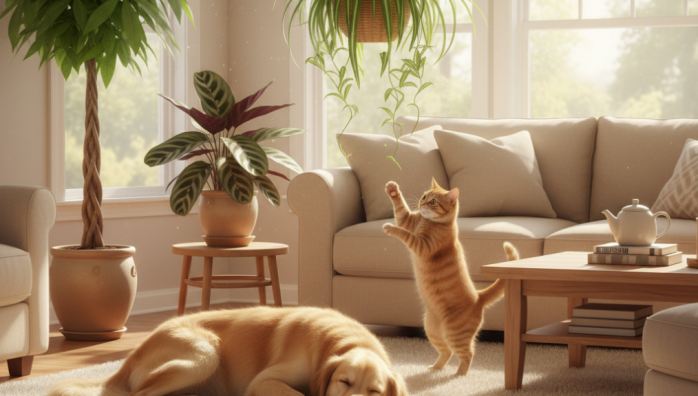
I\'ll never forget the heart-stopping moment I walked into my living room to find my new kitten, Leo, chewing on the leaf of a beautiful dieffenbachia I’d just brought home. I had no idea it was toxic. After a panicked call to the vet and a stressful afternoon, everything turned out okay, but it was a lesson I learned the hard way. Since then, creating a home that’s a lush green sanctuary for me and a completely safe space for my pets has become my top priority.
Why choosing pet-safe plants is a non-negotiable for me
For me, it\'s all about peace of mind. Our pets, especially cats and curious puppies, explore the world with their mouths. A single bite of the wrong plant, like a lily or sago palm, can lead to a devastating emergency. By consciously choosing non-toxic plants, I\'ve eliminated that constant, low-level anxiety. My home feels more relaxed, and I can enjoy my indoor garden without worrying that my furry companions might be in danger. It’s a simple switch that makes a world of difference to a responsible pet parent.
My personal go-to list for beautiful and pet-friendly plants
Over the years, I\'ve curated a collection of gorgeous plants that are completely safe for my dog and cat. These are my absolute favorites that thrive indoors and add life to my space without any risk.
The Spider Plant (Chlorophytum comosum)
This is the classic starter plant for a reason! It\'s incredibly resilient and sprouts little \'spiderettes\' that are fun to propagate. My cat absolutely loves batting at the dangling babies, and I don\'t have to worry a bit. It’s a win-win for both of us.
Prayer Plant (Maranta leuconeura)
I\'m mesmerized by the Prayer Plant. Its leaves, with their stunning pink veins, fold up at night as if in prayer. It adds such a unique touch of beauty and movement to my shelf, and it\'s completely harmless to curious nibblers.
Boston Fern (Nephrolepis exaltata)
If you want a lush, jungle-like vibe, the Boston Fern is perfect. Its feathery fronds look amazing in a hanging basket, which also helps keep it out of a puppy\'s direct path. They love humidity, so my bathroom is where mine lives happily.
Calathea Varieties (Rattlesnake, Orbifolia, etc.)
Calatheas are the drama queens of the plant world with their incredibly patterned leaves. They require a bit more attention to watering, but their beauty is well worth it, and I can rest easy knowing they are pet-approved.
Money Tree (Pachira aquatica)
Often braided and seen as a symbol of good fortune, the Money Tree is another fantastic, non-toxic option. It’s a sturdy little tree that adds height and a different texture to my plant collection. It\'s robust enough to handle the occasional bump from my dog\'s wagging tail.
A quick word of caution: \'safe\' doesn\'t always mean \'edible\'
It\'s important to remember that even though these plants are non-toxic, they aren\'t a salad bar for your pets. Ingesting a large amount of any plant material can cause mild gastrointestinal upset like vomiting or diarrhea. I still do my best to place plants where my pets won\'t be overly tempted to make a meal of them. This is just my personal experience, and I always recommend having a quick chat with your vet if you have any concerns about bringing a new plant into your home.