Identifying Non-Toxic Houseplants for Pets
by admin in Pet Care Basics 188 - Last Update November 30, 2025
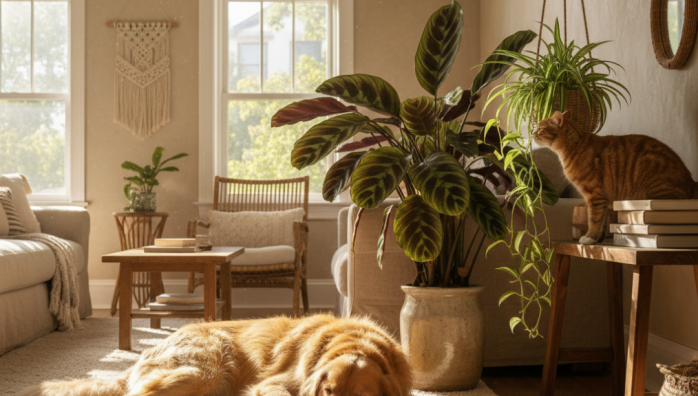
I\'ll never forget the sheer panic that shot through me when I walked into my living room to find my new kitten, Leo, batting at and chewing on a leaf from a plant I\'d just been gifted. My mind raced: Was it poisonous? Would he be okay? That scare was the moment I realized that creating a green, vibrant home couldn\'t come at the risk of my pets\' safety. It sent me down a path of learning, researching, and eventually, cultivating a home filled with beautiful plants that I know won\'t harm my furry family members.
Why \'pet-friendly\' isn\'t always straightforward
One of the first things I learned is that labels can be tricky. A plant might be non-toxic, but that doesn\'t mean it won\'t cause an upset stomach if your dog decides to eat the whole thing. I also discovered that common names for plants can be incredibly misleading, with multiple different species sometimes sharing the same name. My rule of thumb now is to always, always look up a plant by its scientific (Latin) name. That\'s the only way to be 100% sure what you\'re dealing with.
My go-to list of safe and beautiful houseplants
Over the years, I\'ve developed a list of tried-and-true favorites that are gorgeous, easy to care for, and completely safe for my curious crew. These are the plants that bring me joy without any of the worry.
- Spider Plant (Chlorophytum comosum): This is a classic for a reason. It\'s incredibly resilient, great for purifying the air, and my cats absolutely love the little \'spiderettes\' that dangle down. It\'s completely non-toxic and a fantastic starter plant.
- Calathea family (Prayer Plants): I\'m obsessed with the stunning patterns on the leaves of Calatheas. They look like they\'ve been hand-painted. They are a bit more demanding with their watering schedule, but their beauty and pet-safe nature make it well worth the effort.
- Boston Fern (Nephrolepis exaltata): If you want a lush, jungle-like vibe, the Boston Fern is your answer. It\'s feathery, full, and totally harmless to pets. I keep one in my bathroom where it loves the humidity.
- Haworthia (Zebra Plant): For those who love succulents, Haworthia is a fantastic alternative to potentially toxic ones like Jade or Aloe Vera. Its striking stripes give it a unique look, and it\'s perfectly safe for nibblers.
A quick note on what \'safe\' really means
It\'s important to remember that even non-toxic plants can cause minor stomach upset if your pet ingests a large quantity. Think of it like a child eating too much grass—it\'s not poisonous, but it might not sit well! I always try to place my plants in spots where they are less likely to be treated as a salad bar, but I have peace of mind knowing a curious nibble won\'t result in an emergency vet visit.
What to do if you suspect your pet ate a plant
Even with the best intentions, accidents can happen. If you suspect your pet has eaten a plant and you\'re unsure if it\'s toxic, the first thing I do is try to identify the plant. Then, I call my veterinarian or a pet poison control hotline immediately. It\'s always better to be safe and get expert advice. While this guide is based on my personal experience, I\'m not a vet, and their guidance is invaluable in a potential emergency.
Creating a pet-safe indoor jungle has been one of the most rewarding projects. It brings life and color into my home, and I can relax knowing my environment is a true sanctuary for every member of my family, two-legged and four-legged alike.