Crate Training to Prevent Separation Stress
by admin in Pet Care Basics 120 - Last Update December 4, 2025
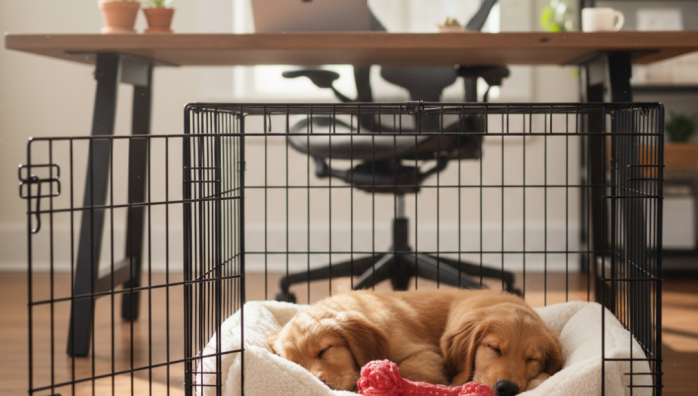
When I first switched to remote work, I thought it was the best thing ever for my dog, Leo. He became my little shadow, snoozing at my feet during calls and reminding me to take screen breaks. But honestly, I created a bit of a monster. The first time I had to leave for a few hours for an appointment, I came home to a chewed-up pillow and a very anxious pup. It hit me hard: by being there 24/7, I hadn\'t taught him how to be okay by himself. That\'s when I revisited crate training, not as a cage, but as a tool to build his confidence and prevent separation stress.
Why crate training is a game-changer for remote workers
It sounds counterintuitive, right? You\'re home more, so why would you need a crate? It took me a while to understand that a crate isn\'t about confinement; it\'s about creating a personal, safe den for your dog. It\'s a predictable space that is theirs and theirs alone. For a dog that\'s used to constant human presence, having this safe zone can drastically reduce the anxiety they feel when the routine suddenly changes and you have to leave. It teaches them independence in a gentle, structured way.
It\'s a safe space, not a punishment
My biggest mental hurdle was the feeling of \'jailing\' my dog. I had to completely reframe my thinking. I started calling it his \'den\' or his \'room.\' I made a strict rule for myself and my family: the crate is only for positive things. It\'s where he gets his favorite puzzle toy, it\'s where he can go to nap undisturbed. We never, ever use it as a timeout spot. This simple shift in perspective was crucial for both of us.
My step-by-step guide to positive crate association
Getting Leo to love his crate didn\'t happen overnight. It was a process of building trust and positive feelings. I was impatient at first and made mistakes, but this is the slow-and-steady method that finally worked for us.
- Make it the best place in the house. I put his favorite soft blanket inside, along with a durable chew toy. For the first few days, the door was always open, and I\'d randomly toss high-value treats in there for him to find.
- Feed meals in the crate. I started placing his food bowl just inside the door, then slowly moved it further to the back with each meal. This created a simple, low-pressure positive association.
- Introduce a verbal cue. I chose a simple, happy-sounding phrase, \'Go to your room!\'. I\'d say it, toss a treat inside, and praise him lavishly when he went in.
- Close the door for seconds. Once he was comfortable going in on his own, I started closing the door for just 5-10 seconds while I was right there, then opened it and gave him a treat. We practiced this repeatedly.
- Gradually increase the duration. The key for me was using a special \'crate-only\' treat, like a frozen KONG filled with peanut butter. I\'d give it to him, close the door, and stay in the room. Then I\'d leave the room for a minute, then five. It was a slow process, but it prevented him from panicking.
Common mistakes I made (and how you can avoid them)
I definitely rushed things at the beginning, which set us back. Learn from my mistakes!
Forcing them in too soon
In a moment of frustration, I tried to nudge Leo into the crate. He immediately became suspicious of it for days. My takeaway: let them go in at their own pace. Lure, don\'t force. Your patience now will pay off tenfold later.
Making a big deal out of leaving or returning
I used to give him a ton of kisses and say \'I\'ll miss you!\' in a sad voice. Big mistake. This just hyped up his anxiety. Now, my departures and arrivals are calm and boring. I give him his crate treat a few minutes before I leave, and when I get back, I ignore him for the first minute or two until he\'s calm, then I let him out. This signals that my leaving isn\'t a major event.
When to seek professional help
Crate training is an amazing tool, but it\'s not a magic cure for severe separation anxiety. What worked for Leo might not be the exact recipe for your dog. If you\'re seeing signs of extreme distress like constant barking, destructive behavior, or self-harm, it\'s really important to talk to a certified professional dog trainer or a veterinary behaviorist. Getting expert advice was a huge help for me, and I always recommend chatting with your vet to rule out any underlying health issues.