Gradual Desensitization for Pet Anxiety
by admin in Pet Care Basics 186 - Last Update December 3, 2025
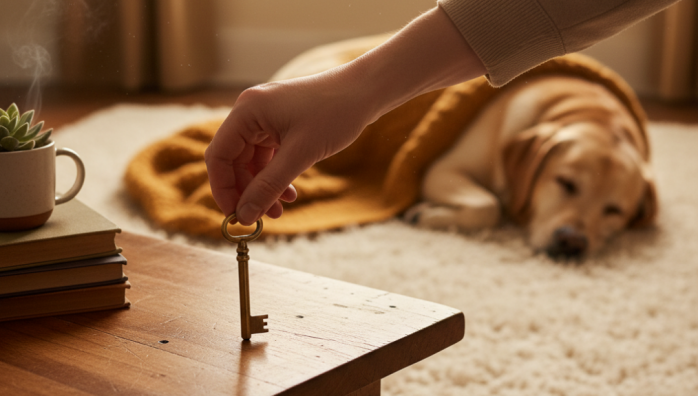
When I first switched to remote work, I thought it was the best thing that could happen for my rescue dog, Leo. More cuddles, more walks, constant companionship. What I didn\'t anticipate was that my constant presence was creating a new problem: the moment I put on shoes or grabbed my car keys for a quick errand, his world would fall apart. The whining, the pacing... it was heartbreaking. I realized I had to reteach him that being alone was okay, and that\'s when I dove headfirst into gradual desensitization.
What is gradual desensitization, really?
Honestly, the term sounds so clinical and complicated, but the concept is beautifully simple. It\'s about slowly and gently breaking the association your pet has between certain cues (like keys jingling) and the stress of you leaving. Instead of one big, scary event (you disappearing for hours), you create dozens of tiny, non-scary \'mini-events\'. It\'s about rebuilding their confidence one baby step at a time, proving to them over and over that you always come back and that those departure cues are no big deal.
My step-by-step process that actually worked
This isn\'t a rigid formula, but this is the flow that brought peace back to our home. The key for me was observing Leo\'s body language and never pushing him past his comfort zone.
Step 1: Making the triggers boring
I started by identifying his triggers. For Leo, it was my shoes, my jacket, and my keys. So, several times a day, I\'d randomly put my shoes on and then just go sit on the couch to watch TV. I\'d grab my keys, jingle them, and then put them back in the bowl. At first, he\'d get tense, but after a few days of these actions leading to nothing, he started to relax. The triggers were losing their power.
Step 2: The \'non-event\' departures
This was the real game-changer. I started with the smallest possible \'departure\'. I\'d walk to the door, open it, step outside, close it, and immediately come back in. No fanfare, no emotional goodbye or hello. I did this until he didn\'t even bother getting up. Then, I extended it to 10 seconds. Then 30 seconds to grab the mail. The goal was to return *before* he could even begin to feel anxious.
Step 3: Building up the duration slowly
Once he was perfectly calm with my 30-second absences, I slowly started to add time. A one-minute trip to take out the recycling. A five-minute walk around the block. I used a pet camera to monitor him, and if I saw him start to pace, I knew I had pushed a bit too far for that day and would aim for a shorter duration next time. It\'s a dance of two steps forward, one step back, and that\'s perfectly okay.
A common mistake I made (so you don\'t have to)
My biggest mistake early on was making a huge fuss when I came home. I felt guilty for leaving, so I\'d shower him with affection the second I walked in. I later learned this actually reinforces the idea that my return is a massive, emotional event, which in turn makes the leaving part feel just as significant. I switched to a calm, quiet entry, waiting a few minutes before giving him gentle pets. It made a world of difference. This entire process is about teaching them that your comings and goings are the most boring part of their day. It takes time and a lot of patience, but seeing your pet resting peacefully when you\'re gone is worth every second. And remember, this is just what worked for us. For severe cases of anxiety, I always recommend chatting with your vet or a certified animal behaviorist to create the best plan for your furry friend.