Crate Training to Reduce Pet Anxiety
by admin in Pet Care Basics 139 - Last Update December 3, 2025
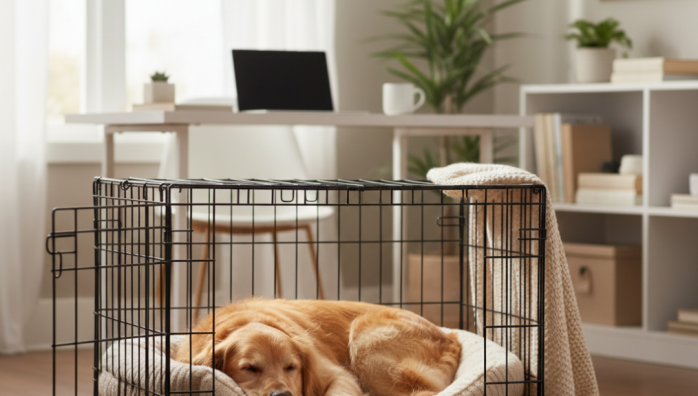
When I first started working from home, I thought it would be a dream for my rescue dog, Leo. More cuddles, more midday fetch sessions, and no more long, lonely days. But I quickly discovered a strange paradox: the more time we spent together, the more intense his anxiety became whenever I had to leave, even just to grab groceries. The whining, the pacing, the frantic barking—it was heartbreaking. I realized our constant togetherness had accidentally created a new, more potent form of separation anxiety. That\'s when I had to completely rethink the role of his crate.
Why the crate became our safe haven, not a cage
Honestly, I\'d always felt a bit guilty about using a crate. It felt like putting my best friend in \'jail\'. But after a lot of reading and talking with other pet owners, I had an \'aha\' moment. The goal isn\'t confinement; it\'s about creating a personal, safe den. Dogs in the wild seek out small, enclosed spaces to rest and feel secure. I needed to transform his crate from a place he *had* to be into a place he *wanted* to be. This mindset shift was the key to everything.
The biggest mistake I made at first
My initial attempts were a disaster. I\'d just put him in, close the door, and leave the room. He\'d cry, and I\'d feel terrible. I learned the hard way that you can\'t just force it. The biggest mistake is creating a negative association from the start. Never, ever use the crate as a punishment for a timeout. You\'re teaching your pet that the crate is a bad place, which completely undermines your goal of making it a sanctuary.
My step-by-step process for positive association
Patience was my mantra. We started from scratch, and it took a few weeks, but the change was incredible. Here\'s the simple process that worked for us:
- Make it the comfiest spot in the house. I put his favorite soft blanket inside, along with an old t-shirt of mine so it smelled like me.
- All good things happen in the crate. I started feeding him all his meals inside the crate with the door open. He began to associate it with something wonderful.
- Introduce a high-value \'crate only\' treat. I got a KONG toy and filled it with a bit of peanut butter. He *only* gets this special treat when he\'s in his crate. It\'s his ultimate reward.
- Start with seconds, not hours. I\'d toss a treat in, he\'d go in, and I\'d close the door for just 5-10 seconds before letting him out and praising him. We slowly, slowly built up the time.
- Practice while you\'re home. This was crucial for my remote work schedule. I\'d have him rest in his crate (with his special toy) while I was on a video call in the same room. He learned that the crate meant quiet time, not that I was abandoning him.
Navigating crate training with a work-from-home schedule
The beauty of being home is that you can integrate these small training sessions throughout the day. I\'d practice \'separations\' by going into another room and closing the door for a few minutes while he was settled in his crate. It desensitized him to the sound of a closing door and the fact of me not being in his direct line of sight. It taught him that separation is temporary and safe.
When to know it\'s working (and when to get help)
The turning point for me was when I found Leo napping in his crate on his own, with the door wide open. He had chosen to be there. Now, when I grab my keys, he often walks to his crate and waits for his special treat. He\'s calm and relaxed. While this process worked wonders for us, every dog is different. If your pet\'s anxiety is severe—involving destructive behavior or self-harm—it\'s incredibly important to seek professional help. This is just my experience, and I always recommend chatting with your vet or a certified animal behaviorist to create a plan that\'s right for your pet.