Desensitization Exercises for Dog Separation Anxiety
by admin in Pet Care Basics 79 - Last Update November 30, 2025
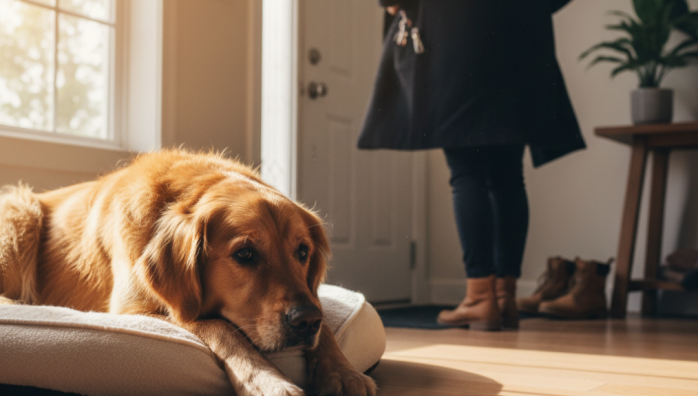
When I first transitioned to working from home, I thought it would be the perfect solution for my dog\'s mild separation anxiety. I was wrong. It actually seemed to make it worse. Because I was always there, the rare times I did have to leave for groceries or an appointment became a massive event for him. The whining, the pacing, the frantic look in his eyes... it was heartbreaking. It took me a while to realize that the key wasn\'t just being home more, but teaching him that my coming and going was no big deal. That\'s when I dove headfirst into desensitization, and honestly, it changed everything for us.
What is desensitization anyway?
Before I started, I thought desensitization was about tricking my dog. But that\'s not it at all. It\'s about slowly and gently reducing the emotional response to a trigger. In this case, the triggers were all the little things I did before leaving the house. The goal is to make these actions so boring and commonplace that they no longer signal an impending, scary absence. We\'re turning a big, scary event into a complete non-event.
Starting with the departure cues
The first step for me was to make a list of everything I did that seemed to set my dog off. Jingling my keys, putting on my \'outside\' shoes, picking up my bag, walking towards the door. Each of these was a tiny building block of his anxiety. I decided to tackle them one by one, in the most low-pressure way possible.
Step 1: The key jingle game
This was our starting point. Several times a day, completely randomly, I would pick up my keys and jingle them. Then I\'d immediately put them down and go sit on the couch or go back to my desk. I didn\'t look at my dog or say anything. The first few times, he shot up, looking worried. But after a dozen repetitions, he\'d just lift his head, then put it back down. The keys no longer meant \'abandonment imminent.\' They just meant a weird bit of noise.
Step 2: Putting on shoes and going nowhere
Once the keys were boring, I moved on to my shoes. I\'d put them on, walk around the living room, and then take them off. Sometimes I\'d put on my coat, too. I\'d grab my bag and take it to the kitchen, then put it back. I was un-linking all these actions from the final act of walking out the door. My dog went from tense and watchful to genuinely confused, and eventually, bored. This was a huge win.
Step 3: The door is not a portal to loneliness
The final cue was the door itself. I started by just walking to the door and touching the handle, then walking away. Then, I progressed to opening the door, stepping out for one second, and immediately stepping back in. The key here was to return *before* he had a chance to get anxious. I\'m talking literally one or two seconds at first. It felt ridiculous, but it was crucial.
Building up the duration slowly
This was the hardest part, and where I made my biggest mistakes. Eager for progress, I once jumped from a 30-second absence to a 5-minute one. I came back to a whining, stressed-out pup, and I knew I\'d set us back. I learned that progress has to be incredibly gradual. We went from 1 second, to 5 seconds, to 10 seconds, to 30, and so on, over many days and weeks. I always came back in with no fuss. No big, emotional \'hello,\' just a calm return that reinforced that my leaving was not a big deal. It\'s a slow process, but seeing him sleep soundly on the dog bed when I check the camera on a 10-minute coffee run is worth every second of training.
Remember, this is what worked for my dog and me. For severe cases of separation anxiety, the distress is very real, and I always believe it\'s best to work alongside a certified professional dog trainer or a veterinary behaviorist to create a safe and effective plan.