Coping Strategies for Pet Separation Anxiety
by admin in Pet Care Basics 199 - Last Update December 1, 2025
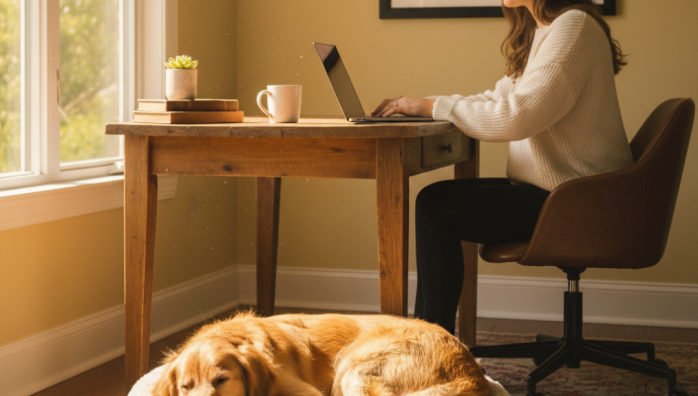
When I first transitioned to a fully remote role, I thought it was the best thing ever for my rescue dog, Finn. He had me all to himself, all day long. The problem, I later realized, was that he got a little too used to it. The first time I had to leave for a full day of errands, I came home to a chewed-up door frame and a very stressed-out pup. It hit me hard; our constant companionship had inadvertently created a classic case of separation anxiety. It was a journey to find what worked, but I learned that helping him cope was about building his confidence, not just managing my absence.
The subtle signs I almost missed
Before the chewed door frame, there were smaller clues. Looking back, I can see them so clearly now. It wasn\'t just about destruction; the anxiety was brewing long before I picked up my keys. If you\'re in a similar situation, you might recognize some of these early warnings:
- The \'Velcro\' Pet: Finn became my shadow, following me from the office to the kitchen to the bathroom. At first, I thought it was cute, but I later understood it was a sign of hyper-attachment.
- Pre-Departure Panic: As soon as I\'d put on my shoes or grab my bag, his whole demeanor would change. He\'d start to whine, pant, or pace. He learned to associate these cues with me leaving, and his anxiety would ramp up immediately.
- Excessive Greetings: When I\'d return, even after just 30 minutes, his greetings were frantic and over-the-top, as if I\'d been gone for days. This wasn\'t just happiness; it was a release of pent-up stress.
My step-by-step approach to building their confidence
Once I identified the problem, I knew I had to act. I read everything I could and spoke with our vet. My approach became a combination of management, desensitization, and enrichment. It wasn\'t an overnight fix, but consistency was our breakthrough.
Creating a \'safe zone\' and positive associations
I realized Finn didn\'t have a space that was truly his own. So, I set up a super comfy bed in a quiet corner of the living room with his favorite blanket and a durable chew toy. Then, the game-changer: I got him a few puzzle toys, like a classic KONG, that he *only* got when I was leaving. I\'d stuff it with something delicious, so he started to associate my departure with an amazing, high-value treat. My leaving slowly turned from a negative into a positive.
The art of the \'fake departure\'
This felt silly at first, but it was incredibly effective. I started desensitizing him to my departure cues. I\'d pick up my keys and then just sit on the sofa. I\'d put my coat on and then go make a cup of tea. He slowly learned that these things didn\'t always mean I was leaving. Then, I practiced actual departures. I\'d walk out the door for just 10 seconds, then come back in calmly, without a big fuss. We slowly worked our way up from seconds to minutes. It taught him that I always come back.
Why mental stimulation is non-negotiable
I learned that a tired, mentally stimulated dog is a less anxious dog. We added more \'sniffing\' walks, where he could just explore at his own pace. We also started doing 5-10 minutes of simple training exercises each day. This mental work tired him out just as much as physical exercise and helped build his confidence in his own abilities, separate from me.
When to seek professional help
I want to be clear that what worked for Finn and me might be different for you. We managed to work through this with a lot of patience and guidance from our vet. However, some cases of separation anxiety are severe and can involve self-harm or extreme destruction. If you feel overwhelmed or aren\'t seeing any progress, please don\'t hesitate. Reaching out to a certified animal behaviorist or a veterinary behaviorist isn\'t a sign of failure; it\'s a sign of responsible and loving pet ownership.