Training Pets for Alone Time Gradually
by admin in Pet Care Basics 198 - Last Update December 6, 2025
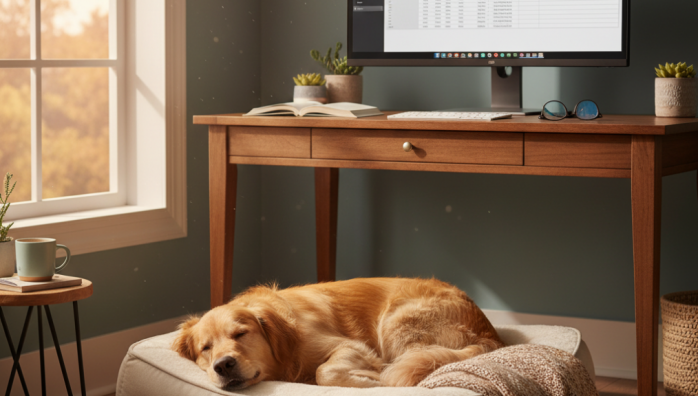
When I first shifted to full-time remote work, I thought it was the best thing ever for my dog, Leo. He had his favorite person around 24/7! But a few months in, I had to run a simple errand, and the feedback from my neighbor was heartbreaking. Leo had howled and cried the entire 30 minutes I was gone. I realized I hadn\'t created a companion; I had created a furry, four-legged shadow who was terrified of being by himself. This was my wake-up call that I needed to teach him that being alone was not just okay, but a normal and safe part of his day.
Why \'alone time\' is a skill, not a given
It took me a while to understand that from my dog\'s perspective, my constant presence had become the new normal. For pets, especially those adopted during the remote work boom, routine is everything. My sudden absence wasn\'t just a change; it was a disruption that triggered his anxiety. I learned that confidence in being alone is a skill we have to build patiently, just like \'sit\' or \'stay\'. It\'s about reassuring them that their world is safe and that you will always come back.
My step-by-step method for building confidence
After a lot of trial, error, and research, I landed on a gradual desensitization process that truly worked for us. It’s all about taking baby steps and making each one a positive experience.
Step 1: Making departure cues meaningless
I realized that Leo started getting anxious the moment I put on my shoes or picked up my keys. These were triggers. So, I started doing those things randomly throughout the day *without* leaving. I’d put on my coat and then sit down to watch TV. I’d jingle my keys and then go make a cup of tea. After a week, he barely lifted his head when he heard the keys. The trigger was disarmed.
Step 2: The art of the \'micro-absence\'
This was the real game-changer. I started by just going to the other side of a door and closing it for 10 seconds, then immediately returning with no fuss. I slowly increased the time: 30 seconds, one minute, five minutes. Then, I progressed to stepping outside to get the mail and coming right back. The crucial part was to return *before* he could escalate into a panic. He learned that separation was temporary and not scary.
Step 3: Creating a sanctuary with high-value rewards
I wanted him to associate my leaving with something wonderful. I bought a few durable puzzle toys and stuffed them with his absolute favorite treats. Here\'s the rule: he *only* gets these special toys when I am leaving. Now, when he sees the puzzle toy come out, he practically ushers me out the door. It’s a powerful positive association.
Step 4: Keeping arrivals and departures boring
This was the hardest part for me! I used to make a huge fuss when I got home because I missed him. But I learned this only reinforces the idea that our separation was a massive event. Now, when I come home, I ignore him for the first minute or two. I put my things down, get a glass of water, and then, once he\'s calm, I greet him quietly. This communicates that my coming and going is a normal, non-eventful part of the day.
When to call in a professional
These steps worked wonders for Leo\'s mild anxiety. However, if a pet is displaying severe signs of distress like destructive behavior, self-harm, or house soiling, it\'s a sign that more help is needed. This is what worked for my dog, but I always recommend chatting with your vet first. They can rule out any medical issues and refer you to a certified veterinary behaviorist or a positive-reinforcement trainer who can provide a plan tailored to your pet\'s specific needs.