Balancing Raw Meat Bone Organs
by admin in Pet Care Basics 129 - Last Update December 5, 2025
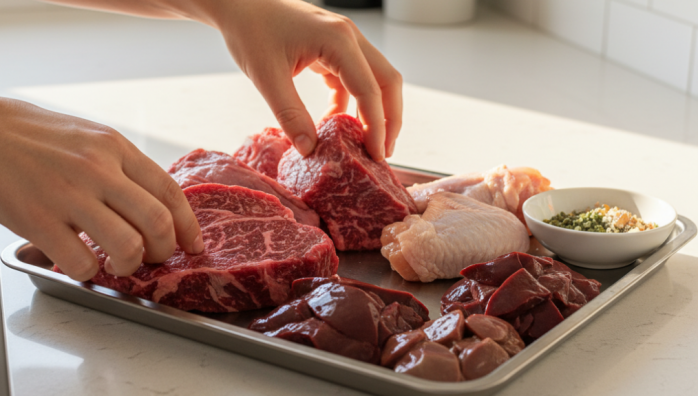
When I first ventured into the world of raw feeding, I felt like I needed a degree in veterinary nutrition. The charts, the percentages, the acronyms... it was overwhelming. The core concept of balancing meat, bone, and organs seemed simple enough, but the fear of getting it wrong was very real. I spent countless hours researching, and honestly, it took a bit of trial and error with my own dog to finally have that \'aha\' moment where it all clicked. This guide is what I wish I\'d had back then—a straightforward look at the fundamentals without the complex jargon.
The foundational ratio: what 80/10/10 really means
You\'ll see the numbers 80/10/10 (or sometimes 80/10/5/5) everywhere in the BARF community. For years, I found it abstract. Here’s how I finally came to understand it in practical terms. It’s a starting guideline, not a rigid rule, representing the prey an animal might eat in the wild. It generally breaks down like this:
- 80% Muscle Meat: This is the bulk of the meal.
- 10% Raw Edible Bone: Essential for calcium, phosphorus, and other minerals.
- 10% Organ Meat: This is where the nutrient density is, with half of it ideally being liver.
Remember, this is a target to aim for over the course of a week, not necessarily in every single meal. Some days might be a bit heavier on meat, others might include a larger bony meal. Balance over time is the key I learned to embrace.
Breaking down the 80% muscle meat
When I first started, I thought \'muscle meat\' just meant a chunk of chicken breast. I quickly learned it\'s much more than that. Muscle meat includes all the fleshy parts of an animal. To ensure a rich profile of amino acids and fats, variety is crucial. I rotate between different proteins like beef, chicken, turkey, lamb, and pork. Don\'t forget that things like heart, gizzards, and tongue are technically considered muscle meats in the BARF world, and they\'re fantastic, nutrient-rich, and often more affordable options.
Getting comfortable with 10% raw meaty bones
This was the scariest part for me. The idea of feeding bones brought up all sorts of safety concerns. The key is \'raw\' and \'edible\'. Cooked bones are an absolute no-go as they become brittle and can splinter. I started with softer bones like chicken wings and necks for my dog, which were easy for him to crunch and digest completely. You have to match the bone to the size and chewing style of your pet. For my dog, a turkey neck is a great meal, but for a smaller cat or dog, it would be far too much. Observing their stools is a great indicator; if they\'re white and chalky, you might be feeding a bit too much bone. It’s a learning process, and I always recommend supervising your pet while they eat bony items.
Understanding the 10% organ meat powerhouse
Organs are the multivitamins of the raw diet. This is where the most concentrated source of vitamins A, D, E, and K, as well as essential minerals like iron and zinc, come from. The guideline is that 5% of the total diet should be liver, and the other 5% should be other secreting organs like kidney, spleen, or pancreas. I learned the hard way that too much organ, especially liver, too soon can lead to very loose stools. My trick was to introduce it very slowly. I\'d chop it into tiny pieces, freeze it in ice cube trays, and add a small, partially thawed cube to meals until my dog\'s system adjusted.
My final thoughts on finding your balance
Perfect balance in every single bowl is an unnecessary stress. The goal is a balanced diet over a week or two. Start simple, introduce new proteins and organs slowly, and pay close attention to your pet. Their energy levels, coat condition, and digestion are the best indicators of how you\'re doing. And most importantly, this is my experience and what worked for me. I always recommend having a conversation with a holistic or pro-raw veterinarian to ensure the plan is right for your specific pet\'s needs.