Balancing Essential Nutrients in Raw Meals
by admin in Pet Care Basics 139 - Last Update December 6, 2025
When I first ventured into the world of raw feeding, my biggest fear wasn\'t handling raw meat; it was the overwhelming feeling that I might miss a crucial nutrient. I spent countless nights staring at charts and spreadsheets, convinced I was on the verge of turning my perfectly healthy dog into a science experiment gone wrong. Honestly, the information overload almost made me quit. It wasn\'t until I simplified my approach and focused on the core principles of the BARF (Biologically Appropriate Raw Food) diet that it all finally clicked.
The basic framework I learned to follow
Instead of trying to be a canine nutritionist overnight, I learned to think in terms of foundational components. This made preparing meals less like a chemistry test and more like building a healthy, balanced plate. For me, it boils down to a few key categories that mimic what a canine\'s ancestor might have eaten.
The foundation: muscle meat
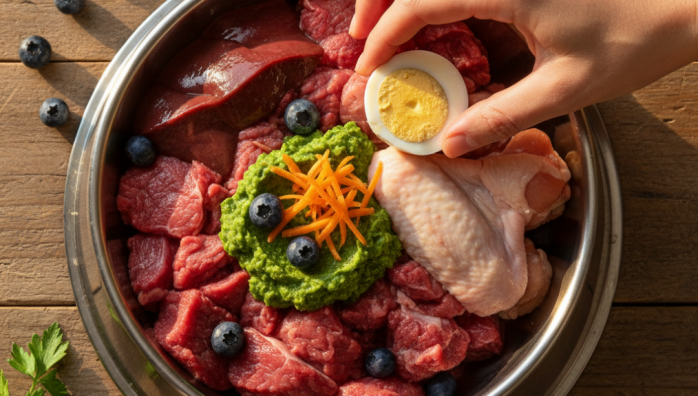
This is the bulk of the meal, typically making up around 70-80% of the food I prepare. It\'s the main source of protein, amino acids, and some B vitamins. I learned quickly that variety is key here. I rotate between beef, chicken, turkey, and lamb to provide a wider range of nutrients. Just feeding chicken forever wasn\'t going to cut it.
The structure: raw meaty bones (RMBs)
This was my biggest \'aha\' moment. Raw meaty bones are nature\'s toothbrush and the primary source of calcium and phosphorus. I aim for about 10% of the diet to be bone. Things like chicken wings, duck necks, or turkey necks work well for my dog. It\'s crucial they are raw—cooked bones are brittle and dangerous. This is one area where I am extra cautious about size and my dog\'s chewing style. I always recommend chatting with your vet about the right type and size of RMB for your specific pet.
The powerhouses: organ meats
I think of organs as the multivitamin of the meal. They should be a small but mighty part of the diet, around 10%. I stick to a simple rule: 5% should be liver, and the other 5% should be another secreting organ like kidney, spleen, or pancreas. When I first started, I added way too much liver, and let\'s just say my dog\'s digestion let me know immediately. A little goes a long way!
My strategy for balance over time
My final breakthrough was realizing I didn\'t have to create a perfectly balanced meal every single day. Nature doesn\'t work that way. Instead, I focus on balance over the course of a week. One day might be heavier on a certain protein, another might include some oily fish like sardines for those crucial Omega-3s, and I\'ll toss in some pureed dark leafy greens or berries a few times a week for antioxidants. This approach took all the stress away and made raw feeding a sustainable, enjoyable part of caring for my best friend.