Balancing Essential Nutrients in BARF Meals
by admin in Pet Care Basics 120 - Last Update November 27, 2025
When I first transitioned my dogs to a raw diet years ago, the single biggest source of my anxiety was nutrient balancing. I’d lie awake wondering, \"Is he getting enough calcium? Too much liver? What about zinc?\" It felt like complex chemistry, and honestly, it was overwhelming. But over time, I learned that balancing a Biologically Appropriate Raw Food (BARF) diet is more about following principles than a rigid, daily formula. It\'s about balance over time, and once I grasped that, everything clicked.
The foundational pillars of a balanced bowl
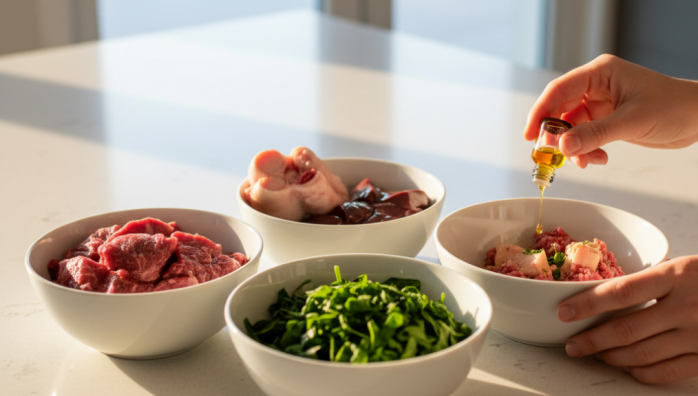
I learned to think of my dog\'s meal in terms of percentages. While these can be adjusted, the classic BARF model gave me a fantastic starting point that I still use today. It took the guesswork out of my daily prep and gave me confidence that I was covering all the essential bases.
80% Muscle meat
This is the cornerstone of the diet. It provides protein, amino acids, and some B vitamins. I rotate proteins constantly—beef, chicken, turkey, lamb. This isn\'t just for variety; different meats have different nutrient profiles. For example, beef heart, while technically a muscle, is incredibly rich in taurine. It\'s one of my non-negotiable ingredients.
10% Edible bone
This was the scariest part for me initially. The key is \'raw\' and \'edible\'. Raw Meaty Bones (RMBs) like chicken wings, duck necks, or turkey necks are the primary source of calcium and phosphorus. Getting this ratio right is crucial for skeletal health. My big \'aha\' moment was realizing that I didn\'t need to hit the exact percentage every single day, but rather aim for it over the course of a week.
5% Liver
Liver is a nutrient powerhouse, packed with vitamin A, D, and iron. However, it\'s incredibly rich, and feeding too much too soon can cause digestive upset. I learned this the hard way! I always introduce it slowly and never let it exceed 5% of the total diet. It\'s a vital component, but one to be respected.
5% Other secreting organs
Kidney, spleen, pancreas, and brain fall into this category. They round out the nutrient profile, offering minerals and vitamins that aren\'t found in high concentrations in muscle meat. I try to get at least two or three different types of organs into my dog\'s meals over a week to ensure a broad spectrum of nutrients.
Mistakes I made that you can avoid
My journey wasn\'t perfect, and I made a few key mistakes. My biggest error was not adding enough variety in the organ meat category. For a while, I only fed liver, and I noticed my dog\'s coat wasn\'t as lustrous. Once I added kidney and spleen into the rotation, I saw a huge improvement. Another slip-up was forgetting about omega-3s. Most farm-raised meat is higher in omega-6s, so I now always add a good quality fish or krill oil to balance that out.
It\'s a marathon, not a sprint
The most important lesson I’ve learned is that perfect balance isn\'t achieved in a single meal. Think about your own diet—you don\'t eat every single nutrient you need every day, but you balance it over a week or a month. The same principle applies here. My advice is to start simple, focus on the core ratios, and observe your dog. Their energy levels, skin, coat, and stool are all great indicators of how they\'re doing. And of course, this is all based on my personal experience with my own healthy adult dogs. I always recommend that you chat with your veterinarian or a certified canine nutritionist before making any big dietary changes.