Starting Your Dog on a BARF Diet
by admin in Pet Care Basics 202 - Last Update December 1, 2025
Honestly, I was so intimidated when I first heard about the BARF diet. The idea of feeding my dog raw meat and bones felt complicated and, frankly, a bit scary. But after years of watching my best friend struggle with persistent itchy skin and lackluster energy on even the most expensive kibble, I knew I had to explore other options. It was a journey of careful research and slow, patient steps, and I want to share what I learned to make it feel less daunting for you.
What the BARF diet really means
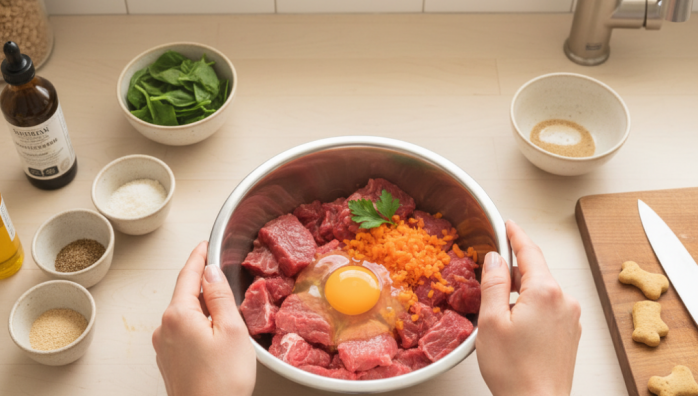
BARF stands for \'Biologically Appropriate Raw Food\'. The name sounded a bit extreme to me at first, but the philosophy behind it made perfect sense. The goal is to mimic the diet of a dog\'s ancestors—a natural diet of raw muscle meat, bones, organs, and some vegetation. It\'s about getting back to basics. For me, the \'aha\' moment was realizing this wasn\'t about some trendy new fad, but about feeding whole, unprocessed foods. The main components I focus on are muscle meat, raw meaty bones, organ meats (like liver and kidney), and a small amount of dog-friendly fruits and vegetables for fiber and antioxidants.
My slow and steady transition plan
The single most important piece of advice I can give is this: go slowly. A sudden switch can wreak havoc on your dog\'s digestive system. This is the gentle, step-by-step process that worked wonders for us.
Step 1: The vet chat
Before I even bought a single ingredient, I had a long conversation with my veterinarian. This is a non-negotiable step. We discussed my dog\'s specific health needs and any potential risks. Their guidance gave me the confidence to move forward. Please, always make your vet your partner in any major dietary changes.
Step 2: A spoonful of raw
I started with just one protein—ground turkey, in our case. For the first week, I simply added one small spoonful of the raw food to his existing kibble meal. I didn\'t change anything else. This gave his digestive system a tiny introduction to the new food without causing a shock.
Step 3: The gradual replacement
Over the next three weeks, I slowly adjusted the ratio. I\'d increase the amount of raw food by a spoonful every few days while decreasing the amount of kibble. I became an expert at monitoring his stool (it\'s not glamorous, but it\'s the best indicator of how well he\'s tolerating the change!). Once his stools were consistently firm, I knew we were on the right track.
Step 4: Introducing variety
After he was fully transitioned and thriving on his new turkey-based diet for a couple of weeks, I began to introduce other proteins one at a time, like beef and lamb. Then, I slowly added small amounts of organ meats. Variety is crucial for providing a wide range of nutrients, but introducing new things slowly prevents digestive upset.
Mistakes I made that you can avoid
I certainly didn\'t get everything right on the first try. Here are a few things I learned the hard way:
- Ignoring balance at first: Early on, I thought just feeding muscle meat was enough. I quickly learned that without the calcium from raw bones and the vital nutrients from organ meats, the diet is dangerously incomplete. A balanced ratio is key.
- Going too fast: I got excited by the initial positive changes and tried to speed up the transition. This led to a temporary bout of diarrhea. Patience truly is the most important ingredient.
- Forgetting the fiber: My dog\'s stools became a bit too hard until I started adding a small amount of puréed pumpkin or finely chopped leafy greens. It made a world of difference for his digestion.
Switching to a BARF diet was a significant commitment, but seeing the shine return to my dog\'s coat, the end of his constant scratching, and his new zest for life has made every bit of effort worthwhile. It\'s a path that requires diligence and education, but with careful planning and professional guidance, it can be an incredibly rewarding choice for your dog\'s well-being.