Mental Enrichment for High-Energy Apartment Dogs
by admin in Pet Care Basics 134 - Last Update November 30, 2025
When I first brought my rescue, a ridiculously smart cattle dog mix, into my city apartment, I thought I had it all figured out. Two long walks a day, plus a weekend hike. That should be enough, right? I was completely wrong. He was still restless, chewing on things he shouldn\'t, and demand-barking in the evenings. It wasn\'t until I had a breakthrough moment that I realized: a tired body doesn\'t always mean a tired mind. For these intelligent, high-drive breeds, mental work is just as crucial as physical exercise.
Why long walks aren\'t always the answer
I learned the hard way that simply adding more miles to our walks wasn\'t solving the core problem. High-energy breeds were bred for jobs—herding, hunting, guarding. These tasks require problem-solving and focus, not just running. When we only focus on physical exercise, we\'re ignoring the part of them that craves a challenge. A bored brain in a capable body is a recipe for destructive behavior, anxiety, and stress, especially in the confined space of an apartment.
My go-to brain games for small spaces
Once I shifted my focus from tiring him out to \'figuring him out\', everything changed. Our apartment became a place of fun and engagement, not just a holding pen between walks. Here are the staples that saved our sanity and our furniture.
Scent work is a superpower
A dog\'s nose is thousands of times more powerful than ours, and putting it to work is incredibly draining for them. I started simple. I\'d have my dog sit and stay, then hide a high-value treat in the room. His job was to \'find it\'. We gradually made it harder, hiding treats under cups or in different rooms. It\'s a fantastic game for a rainy day and requires zero space.
The magic of puzzle toys and feeders
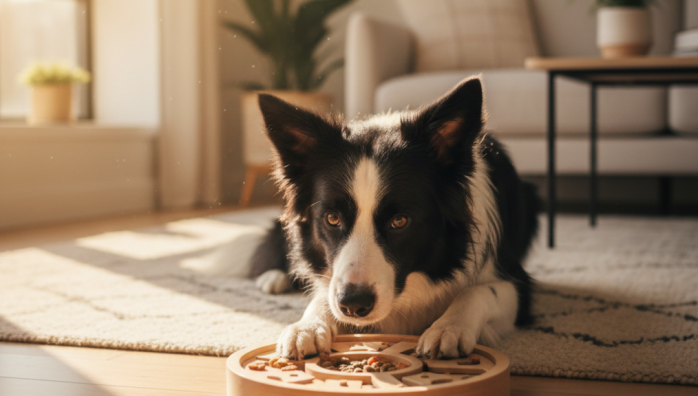
Instead of feeding him from a bowl, which he\'d inhale in 30 seconds, I started using puzzle feeders. These make the dog work for their food, pushing sliders, lifting flaps, or rolling a ball to get kibble out. It turns a 30-second meal into a 15-minute problem-solving session. We have a few different ones that I rotate to keep things interesting. Honestly, this was the single biggest game-changer for his evening restlessness.
Short, sweet training sessions
You don\'t need a big space to practice training. We spend about 5-10 minutes, twice a day, working on new tricks or polishing old ones. Learning a new command, like \'place\' or weaving through my legs, is hard mental work. It strengthens our bond and gives him a \'job\' to do, fulfilling that deep-seated canine need. It\'s about quality, not quantity.
Creating a mentally stimulating environment
Beyond active games, I\'ve found that making his passive environment more interesting helps a lot. I rotate his toys every few days, so an \'old\' toy feels new and exciting again. We also have a designated spot by the window where he can safely watch the world go by. It’s like dog television! Making these small changes has transformed our apartment from a place of confinement into a home where my high-energy companion can truly thrive. It’s a commitment, but the payoff of a calm, contented dog is worth every second.