Daily Exercise for High-Energy Apartment Dogs
by admin in Pet Care Basics 91 - Last Update December 6, 2025
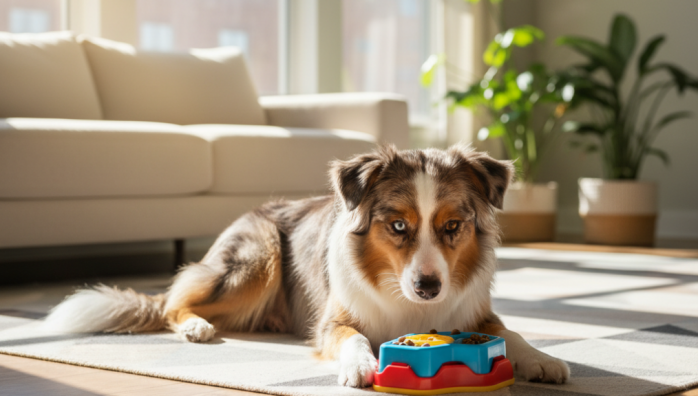
When I first brought my Aussie mix, Leo, home to my 700-square-foot apartment, I had a moment of pure panic. I looked at his boundless energy and my distinct lack of a backyard and thought, \'What have I done?\' For weeks, I thought longer, harder walks were the only answer, but he\'d just come home, pant for five minutes, and be ready to go again. It was exhausting for both of us. It took a lot of trial and error, but I eventually learned that for apartment dogs, especially smart, high-energy ones, the key isn\'t just *more* exercise—it\'s *smarter* exercise.
Rethinking the daily walk
My biggest breakthrough came when I shifted my mindset from \'walking\' to \'exploring.\' Instead of power-walking to tire him out, we started doing what I call \'sniffaris.\' I let Leo lead the way (within reason) and sniff every single bush, post, and patch of grass he wanted. A 30-minute sniffari, where his brain is working hard to process all those smells, tires him out more effectively than an hour of just trotting on a leash. It engages his natural instincts and provides crucial mental stimulation that a simple walk just can\'t match.
The importance of structured play
Physical exertion is still vital, but it has to have a purpose. Indoors, we have a few go-to games that burn off that frantic energy without destroying my apartment.
- Hallway Fetch: We use a soft ball and I\'ll have him practice his \'stay\' and \'drop it\' commands. It’s less about the running and more about the impulse control and focus, which is mentally taxing.
- Tug with Rules: A good game of tug-of-war is fantastic, but I learned it needs rules. We have a clear \'out\' command to release the toy. This teaches him how to switch from high-arousal play to a calm state on my cue.
- Find It (Scent Work): This has been an absolute game-changer, especially on rainy days. I\'ll have Leo stay in one room while I hide a few high-value treats around the living room. Releasing him with a \'Find it!\' command sends him on a mission. Ten minutes of this focused sniffing and problem-solving is like a long walk for his brain.
Brain games are non-negotiable
I can\'t stress this enough: for a high-energy, intelligent dog, mental exercise is just as important as physical. I learned early on that a bored dog is a destructive dog. Puzzle toys, snuffle mats, and lick mats are part of our daily routine. I often feed him his breakfast using a puzzle feeder. It makes him work for his food, slows down his eating, and starts the day with a calming, engaging activity while I get my coffee. Of course, every dog is an individual, so it\'s a good idea to chat with your vet or a certified trainer about the best types of physical and mental exercises for your specific dog\'s needs and health.
Building a routine that works
Consistency is everything. We have a predictable schedule that helps Leo know when to be active and when it\'s time to settle. A quick training session in the morning, a midday sniffari, and an evening puzzle toy create a balanced day that meets his needs without me having to run a marathon. Living with a high-energy dog in a small space isn\'t a limitation; it\'s just an invitation to be more creative and intentional with our time together. And honestly, the bond we\'ve built through all this shared activity is something I wouldn\'t trade for the biggest backyard in the world.