Indoor Exercise for Apartment High-Energy Dogs
by admin in Pet Care Basics 194 - Last Update November 29, 2025
When I first brought Leo, my beautiful but relentlessly energetic Vizsla, home to my city apartment, I honestly had a moment of panic. The four walls suddenly felt like a cage, and I saw a future filled with chewed furniture and noise complaints. I’m a seasoned dog owner, but apartment life with a dog bred to run for miles was a whole new challenge. I learned quickly that physical exhaustion wasn\'t the only goal; mental exercise was the real key to a calm, happy co-habitant.
Why physical exercise isn\'t enough
I used to think a long run would solve everything. We\'d come back, he\'d pant for ten minutes, and then the pacing would start again. The breakthrough for me was realizing that high-energy breeds are also incredibly intelligent. They don\'t just need to run; they need a job to do. Their brains need to be as tired as their bodies. Once I shifted my focus from just \'burning energy\' to \'channeling focus,\' everything changed for us.
My go-to indoor energy burners that actually work
Over the years, I\'ve developed a toolkit of indoor activities that save my sanity on rainy days or when a long trip to the park just isn\'t possible. These aren\'t just time-fillers; they\'re structured sessions that engage Leo\'s mind and strengthen our bond.
Nose work and scent games
A dog\'s nose is thousands of times more powerful than ours, and putting it to work is incredibly draining for them. It\'s my number one recommendation. I started simply by playing the \'which hand\' game with a treat. Now, we do \'find it\' sessions where I hide high-value treats around the apartment while he\'s in a \'stay.\' Watching him methodically search the room is incredible, and afterward, he\'s ready for a serious nap. It’s a quiet game that requires zero space but provides maximum mental stimulation.
The magic of puzzle toys and snuffle mats
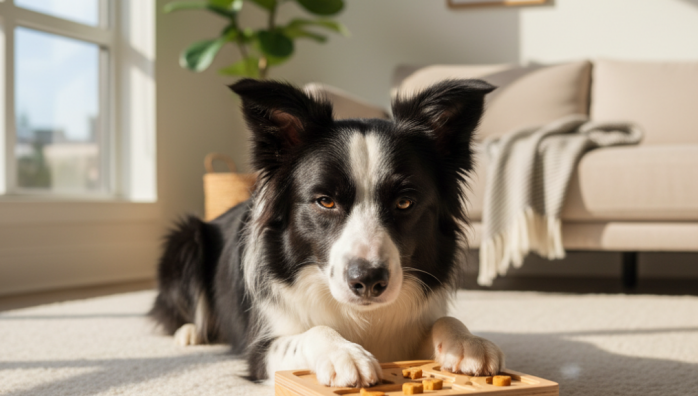
I\'ve learned that feeding from a bowl is a wasted opportunity. Instead, almost every meal for Leo is served in a puzzle toy or a snuffle mat. This forces him to slow down, think, and problem-solve to get his food. It turns a five-second gulp-fest into a 15-minute brain game. I rotate the toys to keep it interesting. Remember to supervise your dog with new toys, but this has been a game-changer for building his confidence and independence.
Structured training sessions (trick training)
You don\'t need a yard to practice training. Short, 10-15 minute sessions working on new tricks or polishing old cues are fantastic mental workouts. We work on things like \'go to your mat,\' learning the names of different toys, or more complex tricks like \'put your toys away\' in a basket. It reinforces our communication and gives him a clear task, which is exactly what these intelligent breeds crave. Always keep it positive and fun!
A quick note on safety
It\'s important to remember that apartment floors can be slippery. I avoid high-impact games like fetch indoors to protect Leo\'s joints. All our games are low-impact and focus on mental engagement. This is just what has worked for my dog and me, but every dog is an individual. I always recommend chatting with your vet or a certified professional trainer to create a plan that\'s safe and suitable for your specific dog\'s needs and health.