Indoor Games High-Energy Apartment Dogs
by admin in Pet Care Basics 77 - Last Update December 3, 2025
Living in an apartment with a dog that has the energy of a thousand suns can feel… challenging. I\'ve been there. I remember staring at my bouncing-off-the-walls pup, feeling a mix of guilt and desperation, especially on rainy days when a long run was off the table. It took me a while to realize that the solution wasn\'t a bigger apartment, but a smarter approach to playtime. The secret? Mental exercise is just as exhausting as physical exercise.
Why indoor games are a game-changer
Before I discovered the power of brain games, I thought tiring out my high-energy dog was all about physical distance—how many miles we could clock. But a bored dog with tired legs is still a bored dog, and that often leads to destructive behavior. Scent work, puzzle-solving, and learning new things engages their mind in a profound way. I\'ve seen my own dog be more settled and content after a 15-minute session of \'find the treat\' than after a 30-minute leash walk. It taps into their natural instincts and gives them a \'job\' to do, which is crucial for so many of these intelligent breeds.
My go-to games for small spaces
Over the years, I\'ve developed a rotation of simple, low-cost games that work wonders in a small living room. These are my absolute favorites for channeling that boundless energy constructively.
The \'find it\' game (nose work)
This is, without a doubt, the most effective tool in my arsenal. It\'s simple to start. I\'d have my dog sit and stay, then hide a high-value treat in plain sight. I\'d release him with the cue \'Find it!\'. As he got better, I started hiding treats in tougher spots—under a rug corner, behind a couch cushion, or inside a cardboard box. It\'s incredible to watch their noses go to work. This game single-handedly curbs so much anxiety and boredom.
Structured tug-of-war
Tug can be a fantastic energy burner, but I learned early on that it needs rules. Our rule is simple: if teeth touch my hand, the game stops immediately. I also practice the \'drop it\' command frequently during play. This teaches impulse control and reinforces that I\'m in charge of the game. We use a designated soft rope toy, so he knows tug is only for that specific item, not the dish towel or my socks.
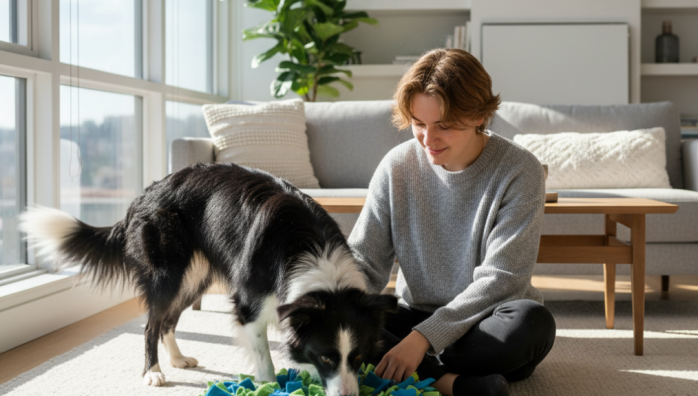
Puzzle toys and snuffle mats
I stopped feeding my dog from a regular bowl years ago. Instead, every meal is an opportunity for enrichment. A snuffle mat, which is a fabric mat with strips for hiding kibble, or a sturdy puzzle toy makes them work for their food. It slows down their eating and engages their problem-solving skills. On days I have to work and can\'t play as much, this is a lifesaver for keeping him occupied.
DIY indoor agility
You don\'t need professional equipment! I create a simple obstacle course using things around the apartment. A row of pillows becomes weave poles. A broomstick laid across two stacks of books becomes a (very low) jump. I use cues to guide him through the \'course\'. It’s not about speed or height; it\'s about listening, focus, and body awareness. Just be sure to play on a non-slip surface and keep things safe. This is a great bonding activity, but always check with your vet to ensure your dog is physically up for this kind of activity.