Indoor Games High-Energy Dog Apartments
by admin in Pet Care Basics 177 - Last Update December 5, 2025
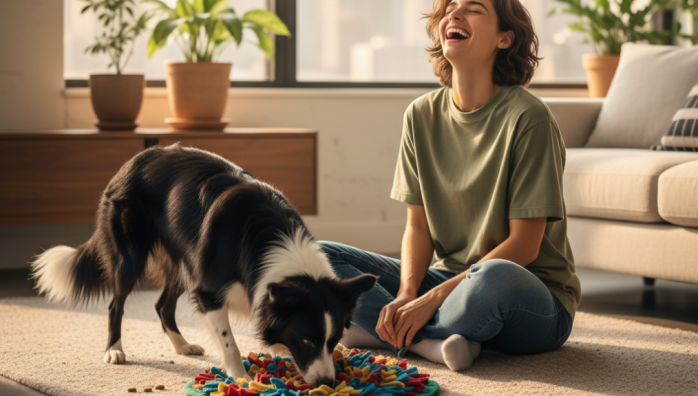
I remember looking at my Aussie, Finn, during his second winter in our city apartment and thinking, \'I\'ve made a huge mistake.\' He had that frantic look in his eyes, the one that says \'If I don\'t do something, this couch is going to explode.\' The guilt was immense. Walks were short due to freezing rain, and the dog park was a mud pit. It forced me to get creative and realize a fundamental truth: for high-energy breeds, mental exercise is just as tiring, if not more so, than physical exercise.
Why a tired dog is more than just a well-walked dog
Honestly, I used to believe that a long run was the only cure for a hyper dog. But I learned that just tires out their bodies, not their brilliant minds. Breeds like Border Collies, Shepherds, and Pointers were bred to think and solve problems. When we don\'t give them a \'job,\' they\'ll invent one—and that usually involves chewing on your favorite shoes or redecorating your living room. Tapping into that problem-solving brain is the key to a calm, happy dog in a small space.
My favorite indoor games that burn serious energy
Over the years, Finn and I have perfected our rainy-day routine. These are the games that have saved my sanity and my furniture, and they require minimal space.
The \'find it\' game
This is scent work for beginners and it\'s our absolute go-to. I started simple. I\'d have Finn sit and stay, show him a high-value treat, and then \'hide\' it under one of three plastic cups in front of him. I\'d shuffle them and say, \'Find it!\' As he got the hang of it, I started hiding treats around the room—first in obvious places, then behind pillows or under a rug. Watching his nose work is incredible. It’s a 15-minute game that leaves him panting and ready for a nap.
Puzzle toys and snuffle mats are a must
I cannot overstate the value of a good puzzle toy collection. We have a rotation of about five different ones. If I give him the same one every day, he solves it in seconds. By rotating them, I keep the challenge fresh. A snuffle mat is also a game-changer for meal times. Instead of him inhaling his food in 30 seconds, I scatter his kibble in the mat, and it takes him 10-15 minutes of focused sniffing to finish his breakfast. That\'s 15 minutes of built-in mental work to start the day.
Structured tug-of-war
Tug gets a bad rap, but I\'ve found it\'s a fantastic way to bond and burn energy if you have rules. My rule is simple: if his teeth ever touch my hand, the game stops instantly. I also taught a solid \'drop it\' command. We play for a few minutes, I ask for a \'drop,\' reward him, and then we start again. It’s a great way to practice impulse control while letting him engage in a natural behavior.
Hallway fetch with a soft ball
Obviously, you can\'t throw a tennis ball around an apartment. But a soft, plush ball or a rolled-up pair of socks works wonders in a hallway. The key here isn\'t the running; it\'s the structure. I use it as a training session, reinforcing \'sit,\' \'stay,\' and \'bring it here.\' The short distance means more reps and more thinking, turning a simple fetch game into a focused obedience drill.
A final thought on apartment life
Living with a high-energy dog in a small space isn\'t about having a perfectly exercised dog every single day. It\'s about being consistent with mental enrichment. These games have become a core part of our bond, proving that you don\'t need a huge backyard to have a fulfilled, happy dog. You just need a little creativity and a willingness to engage their mind.