Indoor Exercise for Active Dogs
by admin in Pet Care Basics 117 - Last Update December 4, 2025
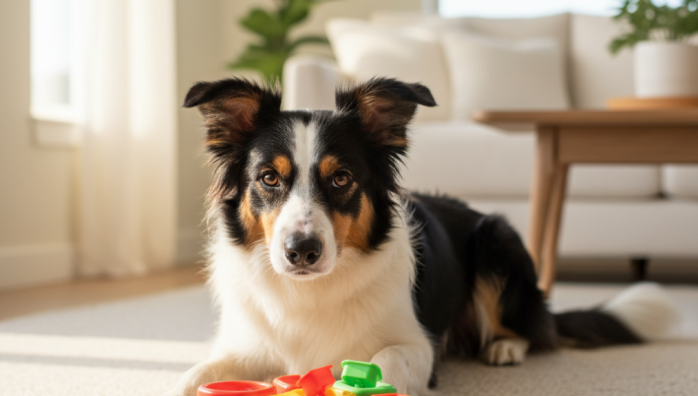
When I first brought my energetic rescue, a Shepherd mix named Leo, into my city apartment, I had a moment of pure panic. I looked at his boundless energy and then at my 700 square feet of living space and thought, \'What have I done?\' The guilt was real. I was convinced he\'d be bored, miserable, and destructive. It took time, a lot of trial and error, and a few chewed-up shoes, but I eventually discovered that keeping a high-energy dog happy indoors is not only possible but can also build an incredible bond.
Why mental exercise is just as important as physical
My biggest \'aha\' moment was realizing that tiring out Leo\'s brain was often more effective than trying to tire out his body. A 15-minute brain game session can exhaust him more than a frantic game of fetch. Mental stimulation taps into their natural instincts to sniff, problem-solve, and work, which prevents boredom and the destructive behaviors that come with it. For us, it\'s been the absolute key to a calm and happy apartment life.
My go-to brain games
- The \'find it\' game: This is our daily ritual. I have Leo sit and stay in one room while I hide a few high-value, smelly treats around the living room. Then I release him with the cue \'Find it!\' Watching him use his nose to solve the puzzle is incredible. We started easy, with treats in plain sight, and now he can find them tucked under rugs or behind couch cushions.
- Puzzle toys and snuffle mats: I\'ve found that investing in a few good puzzle toys was one of the best decisions I made. I use them to feed Leo his meals, which turns a two-minute gulp-fest into a 20-minute engaging activity. Snuffle mats are brilliant for rainy days, mimicking the foraging they\'d do in the grass.
- DIY obstacle course: Using pillows, blankets, and ottomans, I create a simple and safe obstacle course. I guide him to crawl under a blanket-draped chair or step over a line of pillows. It engages his mind and body as he has to think about his movements.
Safe physical exercise for small spaces
Of course, they still need to move their bodies. The trick in an apartment is to do it safely, without breaking lamps or annoying your downstairs neighbors. Low-impact activities are our best friends.
Structured games that work for us
- Tug with rules: Tug-of-war got a bad rap for a while, but I\'ve found it\'s a fantastic energy-burner when played with rules. Our main rule is that the game stops immediately if his teeth ever touch my hand. He also has a solid \'drop it\' cue. It\'s a great way to build our bond and burn off steam in a controlled way.
- Hallway fetch (with a soft ball!): I learned this lesson the hard way. Hard rubber balls are a no-go inside. We use a soft, plush ball or a rolled-up pair of socks for short-distance fetch down our hallway. It\'s more about the repetitive action of retrieving and dropping than a full-out sprint.
- Training sessions: Never underestimate the power of a 10-minute training session. Practicing \'sit,\' \'stay,\' \'down,\' and learning a new trick like \'spin\' or \'play dead\' is surprisingly tiring. It requires immense focus and is a great way to combine mental and physical work.
A quick word on what works for us
Living with an active dog in a small space has been a journey, but it\'s made me a more creative and engaged pet owner. These are the strategies that have turned my high-strung pup into a relaxed companion. However, every dog is an individual. I always suggest chatting with your vet before starting any new exercise routine, just to make sure it’s a good fit for your dog\'s age, breed, and overall health. For us, this combination of brain games and safe physical play has been a lifesaver.