Gradual Departure Training Puppy Anxiety
by admin in Pet Care Basics 106 - Last Update December 5, 2025
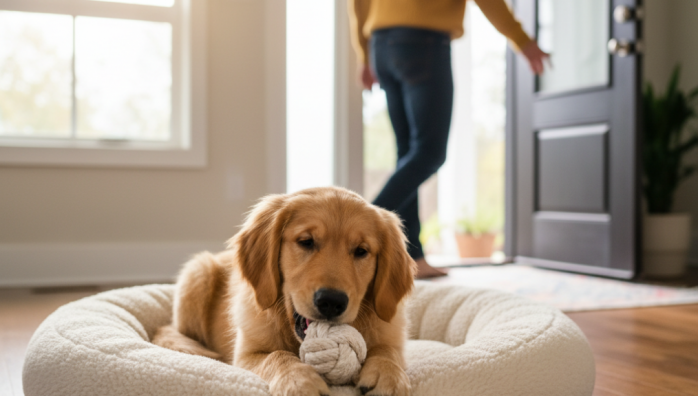
When I first brought my puppy home, my remote work setup felt like a dream come true. I was there for every whimper, every nap, every clumsy pounce. I thought, \'This is perfect, he\'ll never have to be alone!\' Honestly, I was creating a problem without even realizing it. The first time I tried to run a 20-minute errand, the frantic barking I heard from the hallway broke my heart. It was a wake-up call that my constant presence had inadvertently laid the groundwork for separation anxiety.
What is gradual departure training really about?
For me, gradual departure training wasn\'t about just leaving my puppy for longer and longer periods. It was about rewriting the story of what my leaving means. The core idea is to desensitize your puppy to all the little signals that you\'re about to go, and then teach them, in tiny, manageable steps, that being alone is safe and that you always, always come back. It’s a process built on trust, not on \'toughing it out.\' I had to reframe it in my mind as a confidence-building exercise for my little guy.
The step-by-step process that saved our sanity
This isn\'t a race. I learned quickly that pushing too fast would set us back for days. Patience was my most important tool. Here’s the exact progression that worked for us:
- De-fanging the triggers: For a full week, I did nothing but practice the \'pre-departure\' cues. I\'d jingle my keys and then sit down to watch TV. I\'d put on my coat and then start cooking dinner. I\'d grab my purse and just move it to another room. The goal was to make these things utterly boring and meaningless to him.
- The out-of-sight game: I started by simply walking to the other side of a baby gate for 5 seconds, then returning without a word. Then I progressed to closing the door to the bathroom for 10 seconds. I did this dozens of times a day. The key was to return before he had a chance to get anxious.
- The first real departure: This felt like a huge milestone. I took a deep breath, gave him a high-value puzzle toy, and walked out the front door. I stood right outside for just 30 seconds and came back in. I didn\'t make a big deal of it—no emotional goodbyes or frantic hellos.
- Building duration, slowly: From 30 seconds, we went to a minute. Then two minutes. I used a puppy cam to monitor his stress levels. If I saw him start to pace or whine, I knew I had pushed too far and would make the next session shorter. It was a dance of two steps forward, one step back.
What definitely did not work
I have to admit, I made mistakes. My first instinct was to give him tons of cuddles and tell him what a good boy he was right before I left. This only made him more anxious! It was like building up a dramatic farewell. Long, emotional goodbyes are a no-go. Keeping departures and arrivals calm and boring was a true game-changer.
Creating a \'safe and fun\' alone-zone
I realized my puppy needed to associate my leaving with something wonderful, not something scary. His crate became his \'special den.\' I got a few durable food-dispensing toys that he absolutely loves, and he *only* gets them when I am leaving. Now, when he sees me grab one, he often runs into his crate expectantly. It\'s a powerful shift in his emotional response.
This journey took a lot of patience, but seeing my puppy rest peacefully on the camera while I\'m gone is the greatest reward. Remember, every puppy is an individual. This is what worked for us, but for severe cases of anxiety, I always recommend a chat with your vet or a certified positive reinforcement dog trainer.