Crate Training to Reduce Canine Separation Anxiety
by admin in Pet Care Basics 131 - Last Update November 27, 2025
When I first switched to remote work, I thought it was the best thing that could happen for my dog, Cooper. I was home all the time! But I quickly realized a new problem was brewing. The moment I grabbed my keys to run a simple errand, his anxiety would spike. The whining, the pacing... it was heartbreaking. I learned that my constant presence had accidentally created a hyper-attachment, leading to separation anxiety. The solution that truly turned things around for us, surprisingly, was the crate—not as a cage, but as a sanctuary.
Reframing the crate: from cage to den
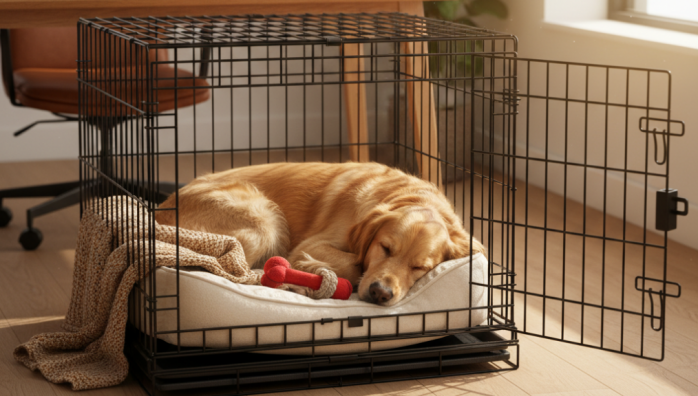
Honestly, I used to feel a pang of guilt just looking at a crate. It felt like a little doggy jail. But after talking with a behaviorist and doing my own research, I had a major mindset shift. For a dog, a crate can mimic a natural den—a safe, enclosed space that\'s all their own. It\'s a place where they can feel secure when the world (or their human leaving the house) feels overwhelming. Once I started seeing it as his private bedroom instead of a punishment box, the entire training process changed for the better.
My step-by-step guide to positive crate association
This isn\'t an overnight fix; it\'s about building trust and positive feelings. Patience was the most important tool I used. Here\'s the gentle process that worked for Cooper.
1. Choosing the right crate and location
First, we needed the right den. I chose a wire crate that was just large enough for him to stand up, turn around, and lie down comfortably. Too much space can encourage them to soil one end and sleep in the other. I placed it in our living room, a central part of the house where he already loved to hang out. It became part of the furniture, not a scary object in a forgotten corner.
2. Making it the best place on earth
The goal is for your dog to enter the crate willingly. I started by tossing his favorite high-value treats inside. I\'d use bits of chicken or a special puzzle toy filled with peanut butter that he *only* got inside the crate. I never forced him in. I just left the door open and let him explore on his own terms. We\'d play games of \'find the treat\' in the crate, and soon he was going in on his own, looking for goodies.
3. The \'door closing\' game
Once he was comfortable going in and out, I started closing the door for just a second, then immediately opening it and giving him a treat. We did this over and over, gradually increasing the time the door was closed—two seconds, five seconds, ten seconds. I stayed right there with him, talking calmly. If he ever showed signs of distress, I knew I\'d moved too fast and went back to a shorter duration.
4. Practicing \'fake\' departures
This was the key for us as remote workers. I started practicing my leaving routine—grabbing my keys, putting on my jacket—and then I\'d just sit back down on the couch. This desensitized him to those trigger cues. Then, I\'d ask him to go in his crate, close the door, walk out of the front door, and come right back in. I started with 30-second departures and slowly worked up to 5 minutes, then 20, then an hour. It took weeks, but his frantic energy at the door was replaced by a calm resignation as he settled into his den.
What I learned to avoid
I made the mistake of trying to comfort him when he whined in the crate early on. This taught him that whining gets attention. The key is to wait for a brief moment of silence before opening the door. Also, never, ever use the crate as a punishment for a household accident or chewing on the wrong thing. It must always remain a positive, safe space. For severe cases of anxiety, this process might not be enough, and I always suggest chatting with your vet or a certified dog trainer to rule out other issues and get a professional plan in place.