Crate Training for Dog Separation Anxiety
by admin in Pet Care Basics 82 - Last Update November 29, 2025
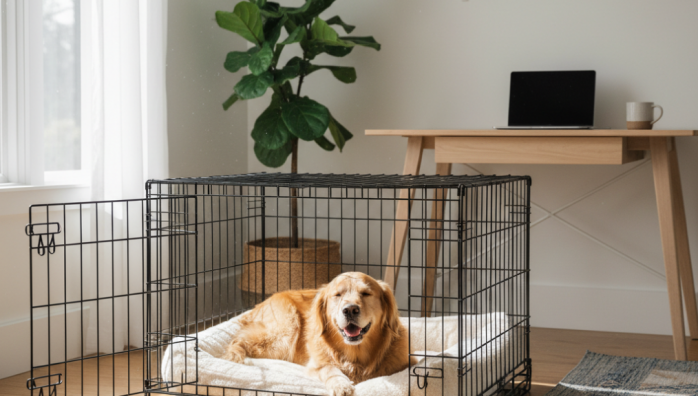
When I first started working from home, I thought it would be the perfect solution for my dog\'s mild separation anxiety. I was there all the time! But I quickly realized that my constant presence was making things worse. A quick trip to the grocery store would result in a panicked pup. That\'s when I decided to revisit crate training, not as a cage, but as a tool to build his confidence and give him a safe space that was all his own. It was a journey, but it completely changed our dynamic.
My shift in perspective on the crate
Honestly, I used to feel guilty about using a crate. It felt like putting my dog in \'jail.\' The biggest breakthrough for me was changing my own mindset. I stopped seeing it as a box for containment and started treating it as his personal den—a cozy, safe retreat where only good things happened. This mental shift was crucial because my dog could sense my hesitation. When I started projecting confidence and positivity about the crate, he started to relax, too.
The very first steps i took (and my mistakes)
I learned the hard way that you can\'t just put a dog in a crate and hope for the best. My first attempt was a failure because I tried to rush it. The key, I discovered, was to go incredibly slowly and make it his choice to go in.
Making the crate the best place on earth
My goal was to make the crate so amazing that he\'d prefer it over any other spot in the house. Here’s what worked for me:
- High-Value Treats: I found a special treat—a bit of freeze-dried chicken—that he would only get when he was in or near his crate.
- Crate-Only Toys: He had a favorite puzzle toy that I started exclusively putting inside his crate. This created a powerful, positive association.
- Cozy Bedding: I put his favorite soft blanket inside, along with an old t-shirt of mine so it smelled like me.
- Meal Time: I started feeding all his meals inside the crate with the door wide open. He began running to his crate excitedly when he heard me preparing his food.
Integrating crate time into my remote work day
This was the game-changer for us. Since I was home, I could practice \'crate time\' without the stress of me actually leaving. I\'d toss a treat inside and say my happy cue word (\'den!\'), and he\'d go in. I\'d close the door for just 30 seconds while I sat at my desk, then open it and praise him. We slowly worked our way up—a minute, five minutes, then the duration of a short work call. He learned that the crate was a place for a relaxing nap while I was nearby, not just a sign that I was about to disappear.
Building up to real departures
Once he was comfortable in his crate while I was home, I started practicing \'fake\' departures. I\'d grab my keys, put on my shoes, lead him to his crate with a special chew, and then just walk out the door for 60 seconds. I’d come back in calmly, without a big fuss. We gradually increased the time. It took weeks of patience, but watching him on the pet camera, I could see him settle down and chew contently instead of panicking. It\'s a process that requires patience, but the peace of mind it brought us both was worth every second. While this method worked wonders for us, every dog is unique, and for severe anxiety, I always recommend chatting with your vet or a certified professional trainer to find the best path forward.