Calming Your Dog's Separation Anxiety
by admin in Pet Care Basics 86 - Last Update November 28, 2025
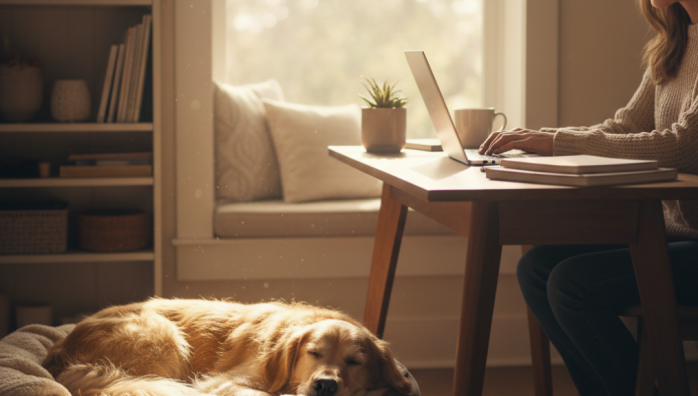
When I first transitioned to working from home, I pictured a blissful scene: my loyal dog snoozing peacefully at my feet all day. The reality, I soon discovered, was quite different. I thought he\'d love having me around 24/7, but it created a new problem I hadn\'t anticipated. The moment I grabbed my keys for a quick grocery run, the whining and pacing would begin. It was heartbreaking and stressful for both of us. This journey taught me so much about the unique challenges of managing separation anxiety when your dog gets used to your constant presence.
The remote worker\'s paradox
The core of the issue, I realized, was that I had accidentally eliminated all \'normal\' alone time from my dog\'s routine. He was so accustomed to me being in the next room that even a short trip to the mailbox felt like a major abandonment. Standard advice didn\'t seem to fit our new WFH lifestyle. I had to unlearn some habits and develop a new strategy that worked for our specific situation.
What didn\'t work for me
Honestly, my first attempts were a total failure. I tried leaving the TV on, which did nothing. I tried making a big, dramatic fuss over him before I left, hoping to reassure him, but I now know that likely just amplified his anxiety. I even tried sneaking out when he was asleep, which only seemed to make him more vigilant and panicked when he woke up to find me gone. It was a frustrating process of trial and error, but each mistake was a learning experience.
My breakthrough strategies that actually helped
After a lot of research and patient experimentation, I landed on a few key things that truly moved the needle. It wasn\'t an overnight fix, but with consistency, I saw a dramatic improvement.
1. Desensitizing departure cues
My dog’s anxiety didn\'t start when I walked out the door; it started the second I put on my shoes or picked up my car keys. This was my biggest \'aha\' moment. So, I started breaking that association. Several times a day, I\'d pick up my keys and then just go sit on the couch. I\'d put on my jacket, walk to the door, and then come right back to my desk. Over time, these actions became meaningless to him, and he stopped seeing them as a guaranteed sign of my departure.
2. Practicing \'alone time\' while still at home
This felt counterintuitive, but it was a game-changer. I started creating short periods of separation while I was still in the house. I\'d use a baby gate to keep him in the living room while I worked in the office with the door closed for 15-20 minutes. I\'d give him a high-value chew to work on during this time, creating a positive association with being on his own. We slowly worked our way up to longer durations.
3. Making my departure the best part of his day
Instead of a sad goodbye, I made my leaving a cause for celebration. I found a few special puzzle toys and KONGs that I would fill with something irresistible like plain Greek yogurt or a bit of xylitol-free peanut butter and freeze. The golden rule was: he *only* got these amazing treats when I was leaving. He soon began to look forward to me grabbing my bag, because he knew his favorite activity was about to happen.
It\'s been a long road, but our home is so much more peaceful now. He\'s learned that me leaving isn\'t scary, and that I always come back. Remember, every dog is an individual, and what worked for us might need tweaking for you. If your dog\'s anxiety is severe, I always, always recommend chatting with your veterinarian or a certified dog behaviorist. They can provide guidance tailored specifically to your best friend\'s needs.