Balancing Nutrients in Beginner BARF Diets
by admin in Pet Care Basics 127 - Last Update November 27, 2025
When I first ventured into the world of raw feeding, honestly, I was terrified. The idea of Biologically Appropriate Raw Food (BARF) made so much sense, but the responsibility of balancing every single nutrient felt like a monumental task. I spent weeks reading, second-guessing every meal, and worrying I was doing more harm than good. It wasn\'t until I stopped trying to be a perfect chemist and started focusing on a few core principles that it all finally clicked. The key isn\'t perfection in every bowl, but balance over time.
The foundational blueprint I follow
The classic BARF model gave me the framework I desperately needed. Instead of thinking about individual vitamins and minerals, I started thinking in terms of food groups. This made meal prep infinitely less stressful. My general target, which I adjust based on my dog\'s needs, is a simple ratio that I aim for over the course of a week, not necessarily in every single meal.
The core components of the diet
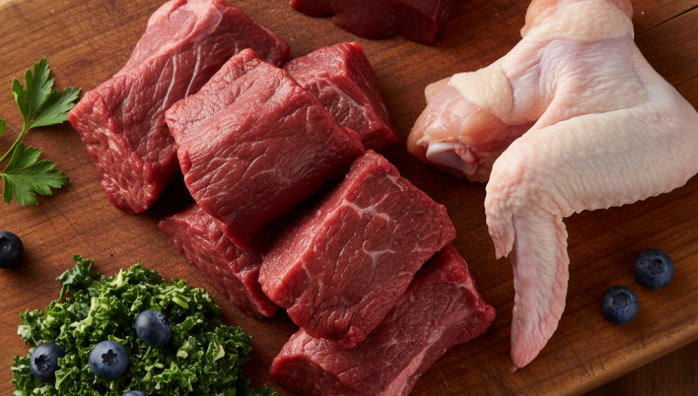
- Muscle Meat (Approx. 70%): This is the foundation. It\'s the main source of protein, amino acids, and B vitamins. I learned early on that variety is crucial here. I rotate between beef, chicken, turkey, and lamb to provide a wider range of nutrients.
- Raw Meaty Bones (Approx. 10%): This was my biggest learning curve. RMBs are the natural source of calcium and phosphorus. Chicken wings, duck necks, and turkey necks became staples in my freezer. Watching my dog happily crunch on a bone is not only great for their teeth but also gives me peace of mind about their skeletal health. Of course, I always supervise this, and I can\'t stress enough how important it is to only feed raw, never cooked, bones.
- Organ Meats (Approx. 10%): I think of organs as nature\'s multivitamin. You only need a small amount, but it\'s non-negotiable. About 5% should be liver (for Vitamin A), and the other 5% should be other secreting organs like kidney, spleen, or pancreas. Too much liver at once can cause digestive upset, a mistake I only made once!
- Vegetables, Seeds & Nuts (Approx. 10%): This part is often debated, but I\'ve found a small amount of puréed, low-glycemic veggies (like kale, broccoli, and pumpkin) and a sprinkle of ground seeds adds valuable fiber, antioxidants, and phytonutrients. It mimics the stomach contents of prey.
The calcium to phosphorus ratio: my biggest hurdle
Getting the Ca:P ratio right felt like advanced algebra at first. But the solution was simpler than I thought: stick to the 10% raw meaty bone guideline. The bones naturally provide calcium and phosphorus in a balanced way. If you skimp on the bones, you risk serious deficiencies. This is one area where I really recommend doing your homework and, as always, having a chat with a vet or a certified canine nutritionist who is familiar with raw diets can be incredibly reassuring.
Fine-tuning for a complete nutritional profile
Once I had the basics down, I started adding a few extras to round things out. A weekly serving of oily fish like sardines provides essential Omega-3 fatty acids for skin, coat, and joint health. An occasional egg (with the shell for extra calcium) is another powerhouse of nutrients. It’s this gentle fine-tuning over time that transforms a basic raw diet into a truly thriving one. My journey from a worried beginner to a confident raw feeder was all about embracing simplicity and trusting the process. It\'s a journey I\'d encourage for anyone, as long as it\'s approached with care and research.