Ramps and Stairs for Older Pets
by admin in Pet Care Basics 138 - Last Update December 6, 2025
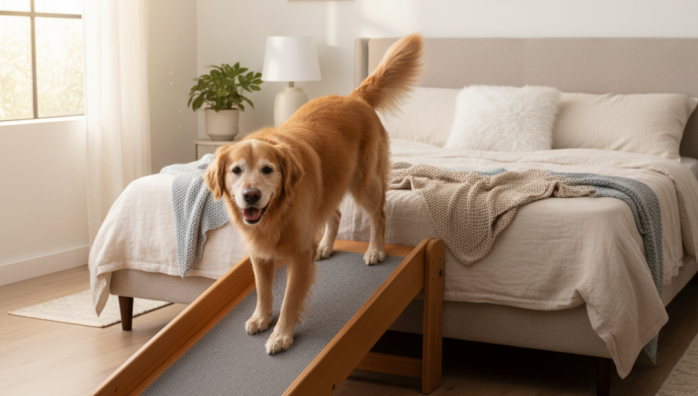
I remember the exact moment I realized my old retriever couldn\'t make the jump onto our bed anymore. It wasn\'t a dramatic fall or a yelp of pain; it was just a quiet hesitation. He\'d walk up to the edge, look up, and then turn away. That simple, silent moment told me everything I needed to know, and it sent me on a mission to find a solution. It\'s a journey many of us with senior pets face: how do we help them maintain their dignity and access their favorite spots when their bodies start to fail them? For us, the answer was found in the world of ramps and stairs.
Recognizing the subtle signs of mobility issues
Before you even start shopping, it’s important to see the need from your pet\'s perspective. It often starts small. For my dog, it was the hesitation. For others, it might be slipping on hardwood floors, a new reluctance to use the stairs to go outside, or taking a running start for a jump they used to make effortlessly. Sometimes you\'ll notice they use an ottoman as a \'mid-point\' to get onto the sofa. These aren\'t just quirks of old age; they\'re signals that your companion could use a helping hand.
Ramps vs. stairs: my personal trial and error
I initially thought stairs were the obvious choice. They take up less floor space and seem like a more natural motion. However, I learned that for some pets, especially those with significant joint pain or a long body like a Dachshund, the act of lifting a leg for each step can still be a strain. A ramp, on the other hand, provides a smooth, gradual incline that is much gentler on the entire body.
The case for pet stairs
Pet stairs can be a great option for pets who are still fairly mobile but just need a little boost. They work well for taller beds or couches and are often more compact. If your dog or cat doesn\'t have severe arthritis and is comfortable with climbing, stairs can be a perfect fit. The key is to find a set with deep, wide steps and a non-slip surface.
Why I ultimately chose a ramp
After trying a set of stairs, I noticed my dog was still a bit stiff after using them. I decided to try a long, low-incline ramp instead. The difference was immediate. He could walk at his own pace without the jarring \'up-and-down\' motion. Ramps are, in my experience, the gold standard for pets with significant arthritis, spinal issues, or post-surgery recovery. They distribute the effort across the whole body rather than concentrating it in specific joints.
What to look for when choosing
Whether you land on a ramp or stairs, some features are non-negotiable. From my own research and a few returns, I\'ve learned to prioritize these things:
- A high-traction surface: This is the most important feature. Look for carpet, rubber, or a textured material. If your pet slips even once, they may never trust it again.
- The right incline or step height: For a ramp, the longer and more gradual the slope, the better. For stairs, the rise of each step should be low enough for your pet to manage comfortably.
- Sturdiness: The unit must be stable and rated for well over your pet\'s weight. Any wobble or flex will scare them off.
- Portability: If you plan to use it for both the couch and the car, look for a model that is lightweight and folds easily.
A final thought on training
Don\'t expect your pet to use it right away. It\'s a strange new object in their environment. I had to use a trail of high-value treats for a week to coax my dog up our ramp. Make it a fun game, never force them, and be patient. Seeing them reclaim their favorite spot, pain-free, is worth all the effort. This was my journey, but every pet is an individual. I always recommend having a chat with your veterinarian to discuss the best mobility support for your furry family member\'s specific health needs.