Choosing Orthopedic Beds for Aging Pets
by admin in Pet Care Basics 153 - Last Update December 1, 2025
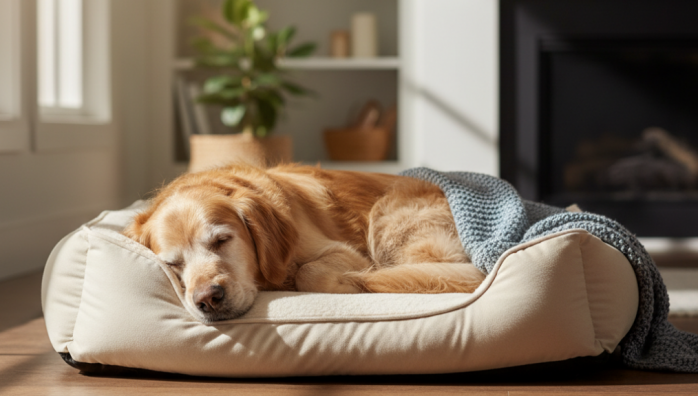
I remember the exact moment I realized my old Golden Retriever, Leo, needed more than just a fluffy cushion. He’d try to stand up after a long nap, and the stiffness in his back legs was just heartbreaking. He’d circle a spot three or four times before gingerly lowering himself down. That\'s when I dove headfirst into the world of orthopedic beds, and honestly, it changed his quality of life for the better.
What truly makes a bed orthopedic?
The term \'orthopedic\' gets thrown around a lot, but from my experience, it boils down to one key thing: genuine support. It\'s not about being soft; it\'s about preventing your pet\'s joints from sinking through the material and hitting the hard floor. A true orthopedic bed supports the body, maintains spinal alignment, and alleviates pressure on sensitive joints like hips and elbows.
The heart of the matter is memory foam
After trying a few different types, I learned that not all foam is created equal. The gold standard is high-density, solid memory foam. Cheaper beds often use shredded foam or an \'egg crate\' style topper on a basic foam base. While better than nothing, a solid slab of memory foam provides consistent, even support that contours to your pet\'s body. When you press your hand into it, it should slowly return to its shape. That\'s the sign of quality I now look for.
Size and easy access are crucial
One mistake I made initially was getting a bed that was just a bit too small. A senior pet needs to be able to stretch out completely without a leg or their head hanging off the edge. I also learned to favor beds with a lower profile or a \'bolster\' design that has a lower entry point. A bed that’s too high can be a challenge for a pet with achy hips to climb into, defeating the purpose entirely.
Don\'t overlook the cover
This might seem like a minor detail, but for a senior pet, it\'s a big deal. Accidents can happen, and joints can get leaky. A waterproof inner liner and a removable, machine-washable outer cover are non-negotiable in my book. It makes cleanup a breeze and keeps the bed hygienic, which is vital for your pet\'s overall health.
My personal checklist before buying
Over the years, I\'ve developed a simple checklist. Does it have solid, high-density memory foam? Is it large enough for my pet to fully sprawl out? Can they get in and out easily? And does it have a waterproof, washable cover? If a bed ticks all those boxes, I know I\'m making a good investment in my furry friend\'s comfort. While these beds can be an investment, seeing the relief on your pet\'s face as they settle in for a sound, comfortable sleep is priceless. Of course, a bed is a supportive tool, and if your pet is showing signs of pain or severe stiffness, a chat with your veterinarian is always the most important first step.