Assistive Devices for Senior Pet Mobility
by admin in Pet Care Basics 122 - Last Update November 29, 2025
I\'ll never forget the moment it truly hit me. My old Golden Retriever, who had spent a decade launching himself onto the couch with joyful abandon, just stood there, looking from me to the cushion with a confused, sad expression. He tried to jump, but his back legs just wouldn\'t cooperate. It was more than just a sign of aging; it was a loss of dignity for him, and frankly, it broke my heart. That was the day I stopped seeing his mobility issues as an inevitable decline and started seeing them as a problem I could help solve.
Recognizing the subtle cries for help
Before that big, obvious moment, there were smaller signs I’d brushed off as him just being a \'senior\'. A little hesitation before going down the deck stairs. A slight slip on the hardwood floor. Taking a bit longer to get up from his bed in the morning. I think many of us do this; we don\'t want to admit our vibrant companions are getting frail. But these little things are the first signals that their world is becoming more challenging. Acknowledging them isn\'t sad—it\'s the first step toward helping.
My journey through different mobility aids
Once I opened my eyes, I dove into the world of assistive devices. It was overwhelming at first, but I learned that you can start small and build up as needed. Every pet is different, but this was the progression that worked for us.
Starting simple: creating a safer home environment
My first changes were the easiest. I replaced his old, flattened bed with a thick, memory foam orthopedic one. The difference was immediate; he seemed less stiff in the mornings. I also laid down runner rugs in all the high-traffic areas where we had tile or wood floors. This gave him the traction and confidence he needed to walk around without fear of his paws sliding out from under him.
Leveling up: ramps and stairs
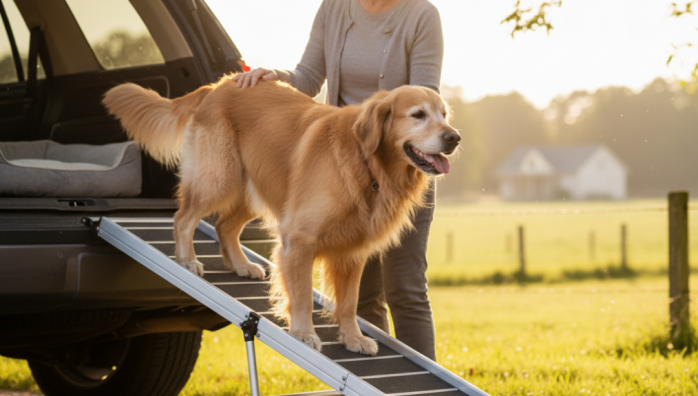
The car was our next big hurdle. Lifting a 75-pound dog isn\'t easy or particularly safe for either of you. I invested in a folding ramp. Honestly, he was terrified of it at first. It took a week of patience, laying it flat on the ground and luring him across with his favorite treats, before he\'d even consider walking up it into the car. But that persistence paid off, restoring his ability to join us on trips he loved.
The game changer: support harnesses
For me, the single most impactful device was a simple rear-lift harness. It\'s a padded sling with handles that goes around their hindquarters. It allowed me to take the weight off his weak hips, helping him up the last couple of stairs or giving him stability on his way out to the yard. It felt like I was lending him my strength, and it seemed to restore his confidence immensely. Getting one that fits properly is crucial, so be sure to measure your pet carefully.
When more support is needed: braces and wheelchairs
Thankfully, we never got to the stage of needing a full wheelchair, but I did a lot of research just in case. They aren\'t just for paralyzed pets. They can provide incredible freedom for animals with severe arthritis or degenerative conditions. This is an area where I absolutely believe professional guidance is non-negotiable. A poorly fitted wheelchair can do more harm than good, so this is a conversation to have with your veterinarian or a veterinary rehabilitation specialist.
It\'s not giving up, it\'s lifting them up
Introducing these tools wasn\'t admitting defeat. It was an act of love. It was about telling my old friend that his life was still full of value and that I would do everything I could to ensure he was comfortable, safe, and happy. These devices gave us more quality time together, more tail wags, and more shared adventures. If you\'re seeing those early signs in your own pet, please know there is so much you can do. As always, this is just my personal experience, and I strongly recommend discussing any new device or significant change with your trusted veterinarian to create the best plan for your pet\'s specific needs.