Performing CPR on Your Dog or Cat
by admin in Pet Care Basics 151 - Last Update November 29, 2025
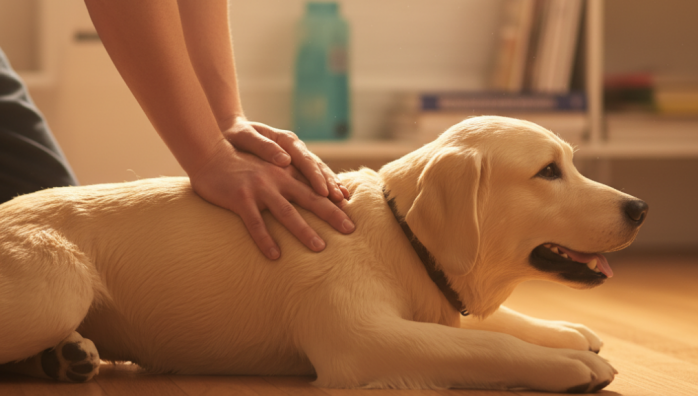
I\'ll never forget the sheer panic I felt when my older dog, Buster, choked on a piece of a toy. He was gasping, and for a few terrifying seconds, I completely froze. I had no idea what to do. Thankfully, he managed to cough it up himself, but the incident shook me to my core. It made me realize that loving my pets wasn\'t enough; I needed to know how to save them. That week, I signed up for a pet first aid and CPR course, and honestly, it was one of the most empowering things I\'ve ever done as a pet owner. Knowing these skills is something you hope you\'ll never need, but it provides a profound sense of peace.
A very important disclaimer first
Before we go any further, I need to be crystal clear. This guide is meant to be an emergency bridge to get your pet to a veterinarian. It is not, and never should be, a substitute for professional veterinary care or a hands-on training course from a certified instructor. I\'m sharing what I learned to help you be prepared in a worst-case scenario, but I always recommend taking an in-person class to practice these techniques on a manikin. Performing CPR incorrectly can cause harm, and it should only be done on an animal that is unconscious, not breathing, and has no pulse.
The first steps: check the A-B-Cs
Before you even think about starting compressions, you have to assess the situation. In the pet first aid world, we use the \'A-B-C\' method: Airway, Breathing, and Circulation.
A: Airway
First, check if your pet is responsive. Call their name and gently touch them. If there\'s no response, carefully open their mouth. Pull the tongue forward and look for any obstructions. If you see something, try to sweep it out with your finger, being very careful not to push it further down or get bitten if your pet should suddenly regain consciousness.
B: Breathing
With the airway clear, check for breathing. Look for the rise and fall of the chest. Put your cheek near their nose and mouth to feel for breath. Listen for any sounds of air moving. If you don\'t detect any breathing for 10 seconds, you need to move to the next step.
C: Circulation
Check for a pulse. The easiest place to find it on a dog or cat is the femoral artery, located high on the inside of their back leg, right where it joins the body. Press gently with two fingers. If you can\'t feel a pulse and they aren\'t breathing, it\'s time to begin CPR.
How to perform CPR on your pet
The goal of CPR is to manually pump the heart to keep blood and oxygen flowing to the vital organs until you can get to a vet. The technique varies slightly based on the size of your animal.
- Call for help. If someone else is there, have them call the nearest emergency vet clinic to let them know you\'re on your way while you begin CPR.
- Position your pet. Lay your dog or cat on their right side on a firm, flat surface. Their back should be toward you.
For medium to large dogs (over 30 lbs / 14 kg)
Place the heel of one hand over the widest part of their chest, right behind their elbow. Place your other hand on top and interlock your fingers. With your arms straight, push down hard and fast, compressing the chest about one-third to one-half of its depth. The rate is crucial: aim for 100 to 120 compressions per minute. A trick my instructor taught me is to pump to the beat of the song \"Stayin\' Alive.\"
For small dogs and cats (under 30 lbs / 14 kg)
For these smaller animals, you can often use a one-handed technique. Place your hand around their chest so your thumb is on one side and your fingers are on the other, just behind their elbows. Squeeze your hand to compress the chest. For very small puppies or kittens, you can use just your thumb and forefinger. The rate is the same: 100 to 120 compressions per minute.
The full cycle: compressions and breaths
The standard cycle is 30 chest compressions followed by 2 rescue breaths. To give a rescue breath, hold your pet\'s muzzle closed with your hands and breathe directly into their nose until you see the chest rise. Give two breaths, then immediately resume the 30 chest compressions. Continue this cycle while you are on your way to the vet.
The most important step: getting professional help
I can\'t stress this enough: CPR is a temporary measure. Your primary goal is to get your pet to an emergency veterinarian as quickly and safely as possible. The chances of survival increase dramatically with professional medical intervention. Having someone drive while you perform CPR in the back seat is the ideal scenario. It\'s a terrifying thought, but being prepared has replaced my fear with a quiet confidence that, if the worst should happen, I know how to give my best friend a fighting chance.