Performing CPR on a Choking Dog
by admin in Pet Care Basics 288 - Last Update December 1, 2025
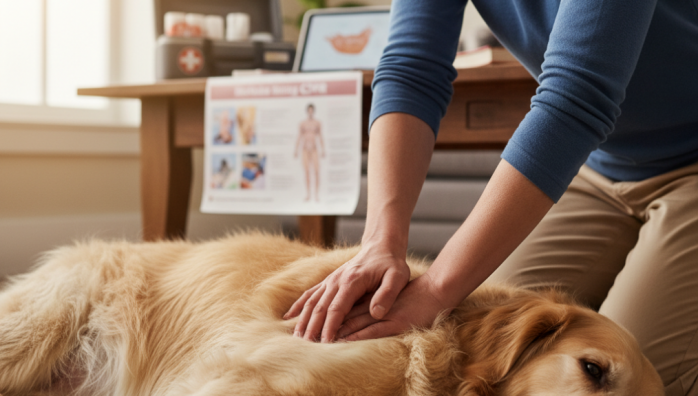
I\'ll never forget the sheer panic I felt. My golden retriever, Max, was playing with a new chew toy when he suddenly went silent, pawing at his mouth with a look of terror. My heart dropped. In that moment, all the \'what if\' scenarios I\'d ever worried about became a terrifying reality. It\'s a situation no pet owner ever wants to face, but knowing what to do can make all the difference. After that scare, I immediately enrolled in a pet first aid course, and what I learned was invaluable. I want to share the essential steps, not as a replacement for vet care, but as a bridge to get you there.
First things first: is your dog actually choking?
Before you even think about CPR, you need to assess the situation. Is your dog coughing forcefully? That\'s a good sign! It means air is still moving, and their own reflexes are working to dislodge the object. Encourage them, but don\'t interfere. The real emergency begins when the coughing stops, they can\'t make any sound, they\'re pawing desperately at their face, or their gums start to turn blue or grey. This is when you need to act.
Step 1: check the airway
Carefully open your dog\'s mouth. I learned to be very cautious here, as a panicking dog can bite, even one you love and trust. Pull their tongue forward to get a clear view of the back of the throat. If you can see the object and can easily grab it with your fingers or a pair of pliers, do so. But be careful not to push it further down. If you can\'t see it or can\'t reach it, you need to perform the Heimlich maneuver for dogs.
Step 2: the dog Heimlich maneuver
This was the part that surprised me most in my training; it\'s different depending on the dog\'s size. For a small dog, you can pick them up and hold their back against your stomach. For a large dog like my Max, you stand behind them and wrap your arms around their belly. Make a fist with one hand and place it in the soft, hollow spot just behind the rib cage. Grasp that fist with your other hand and give a few quick, sharp thrusts inward and upward. After a few thrusts, check their mouth again. The goal is to dislodge the object, not to start CPR yet.
When CPR becomes necessary
CPR is a last resort. You only begin CPR if the choking object has been cleared (or you can\'t clear it), and your dog is unconscious, is not breathing, and has no heartbeat. It is a critical, life-saving intervention meant to keep oxygenated blood flowing to the brain until you can get to an emergency veterinarian.
The A-B-Cs of dog CPR
- Airway: Ensure the airway is clear. Open their mouth, pull the tongue forward, and quickly sweep for any remaining obstructions.
- Breathing: If your dog is not breathing, you\'ll need to perform rescue breaths. Close your dog\'s mouth and breathe directly into their nostrils for two breaths, just enough to see their chest rise. I was taught to be gentle here; you don\'t want to over-inflate their lungs.
- Circulation: Start chest compressions. Lay your dog on their right side on a firm surface. For medium to large dogs, place your hands over the widest part of their chest. For barrel-chested dogs like Bulldogs, you may need to have them on their back. The rhythm is key: aim for 100-120 compressions per minute. A good trick I learned is to pump to the beat of the song \"Stayin\' Alive.\" The cycle is 30 compressions followed by 2 rescue breaths.
Continue this cycle while someone else is driving you to the nearest emergency vet. Performing CPR is physically and emotionally exhausting, but it can provide your dog with their only chance of survival. Please remember, this guide is for emergency use only. I strongly, strongly recommend every pet owner take a certified pet first-aid and CPR class. It\'s the best way to be truly prepared for the unthinkable.