Basic Wound Care for Pet Emergencies
by admin in Pet Care Basics 164 - Last Update December 3, 2025
I\'ll never forget the first time my dog, a boisterous young Lab, came bounding back from the garden with a yelp and a bleeding paw. My heart jumped into my throat. In that moment of panic, I realized that for all the love and training I\'d given him, I was completely unprepared for a simple injury. It was a wake-up call that taught me a crucial lesson: knowing basic wound care isn\'t just a \'nice to have\' skill; it\'s a fundamental part of responsible pet ownership.
The first moments are critical: staying calm
The most important thing I\'ve learned over the years is to take a deep breath before I do anything else. Our pets are incredibly attuned to our emotions. If I\'m frantic, my dog will be frantic, which makes everything harder and more dangerous. I always start by calmly securing my pet in a safe, well-lit space and assessing the situation. Is it a minor scrape or something that needs immediate veterinary attention? A calm mind makes that distinction much clearer.
My go-to steps for a minor cut or scrape
Once I\'ve determined it\'s a superficial wound that I can handle at home, I follow a simple, consistent process. Remember, this is for minor injuries only, and I always recommend having a chat with your vet to create a first-aid plan that\'s right for your specific pet.
Here\'s my routine:
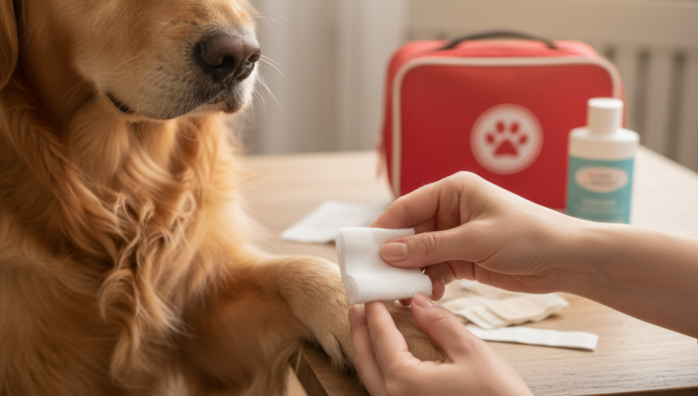
- Stop the bleeding: I take a clean cloth or sterile gauze pad and apply gentle, steady pressure to the wound for a few minutes. For small scrapes, this is usually all it takes.
- Clean the area gently: Once the bleeding has stopped, I carefully trim any hair around the wound with blunt-nosed scissors. Then, I flush the area with a sterile saline wound wash. In a pinch, lukewarm water works too. I avoid scrubbing, as that can cause more pain and damage.
- Pat dry and assess: After cleaning, I gently pat the area dry with a fresh piece of gauze. This gives me another chance to look closely and make sure there\'s no debris still in the wound.
- Leave it be or cover loosely: For most small scrapes, I\'ve found that leaving them open to the air in a clean environment is best for healing. If my dog is likely to lick it, I\'ll use a pet-safe cone or a very loose, breathable bandage, making sure it’s not tight enough to cut off circulation.
What I\'ve learned never to use
In my early days as a pet owner, I made the mistake of thinking human first aid products were interchangeable. They\'re not. I now know to never use things like hydrogen peroxide or rubbing alcohol on a pet\'s wound. These can actually damage healthy tissue and delay healing. I also never apply human ointments or creams unless specifically instructed by my vet, as many are toxic if ingested when our pets inevitably lick the area.
When to skip the home care and call the vet
My personal rule is simple: when in doubt, call the vet. There are some situations that are non-negotiable emergencies. If a wound is deep, bleeding uncontrollably, is a bite from another animal, or has something embedded in it, I don\'t hesitate. Those situations are always beyond the scope of home first aid. Being prepared is about knowing your limits as much as it is knowing what to do.