Indoor Games for Active Apartment Dogs
by admin in Pet Care Basics 114 - Last Update November 28, 2025
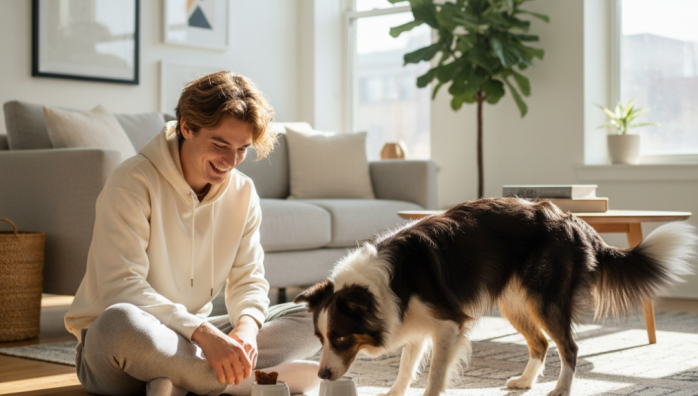
When I first brought my high-energy Aussie mix, Leo, home to my 700-square-foot apartment, I had a constant, nagging sense of guilt. I\'d see photos of his breed frolicking in huge, grassy yards, and I\'d look at him, buzzing with energy, and think, \'Have I made a huge mistake?\' The frantic evening zoomies and the whining from boredom were real. It took me a while to realize that the size of my home wasn\'t the problem; it was the size of my imagination.
Mental stimulation is just as tiring as physical exercise
This was my \'aha\' moment. I had been so focused on physical mileage from walks that I completely overlooked the power of brain work. A 15-minute session of focused \'sniffing\' or problem-solving can tire a dog out more than a 30-minute leash walk. Once I leaned into this, everything changed for us. It became less about running him ragged and more about engaging his incredible mind.
The classic \'find it\' game
This is, hands down, our favorite game. It taps directly into a dog\'s most powerful sense: their nose. I started simple. I\'d have Leo sit and stay while he watched me place a high-value treat in plain sight a few feet away. Then I\'d release him with the cue \'Find it!\'. He caught on instantly. Over weeks, I progressed to hiding the treat in another room, under a pillow, or inside a loosely closed box. Watching him work a room, nose twitching, is one of my greatest joys. It\'s a fantastic confidence builder for them.
DIY puzzle toys and snuffle mats
You don\'t need to spend a fortune on fancy puzzle toys. Honestly, some of the best ones I\'ve used are homemade. My go-to is a simple muffin tin. I place a few pieces of his kibble in some of the cups and cover all of them with tennis balls. Leo has to figure out which cups hold the prize. Another great one is just rolling up treats in an old towel. This \'snuffle towel\' keeps him busy and focused, preventing him from getting bored and destructive.
Hide-and-seek with a twist
This game is brilliant because it reinforces the \'stay\' and \'come\' commands while being incredibly fun. I\'ll have Leo stay in the living room while I go \'hide\' (not too well at first!) in the bedroom or behind a door. Then I\'ll call out, \'Ready or not, here I come!\' in an excited voice. The pure delight on his face when he finds me is priceless. It\'s a powerful bonding experience that doesn\'t require any space at all.
Structured indoor fetch
Yes, you can play fetch in an apartment! The key is structure and safety. We use a long hallway. I only use soft toys that won\'t damage the walls or make a loud thud for my downstairs neighbors. Most importantly, this isn\'t a wild, free-for-all. It\'s a training session. We practice a calm \'drop it\' and \'wait\' before each throw. This impulse control is a fantastic mental workout in itself.
A quick note on safety
Before we start any indoor play, I do a quick sweep. I move fragile items, put away anything he could knock over, and make sure the floor isn\'t too slippery. It\'s also about being a good neighbor; we avoid heavy jumping or playing with hard, loud toys late at night. Remember, a tired dog is a good dog, but a safe dog is even better. This is what has worked wonders for Leo and me, but every dog is different, so I always recommend chatting with your vet or a certified trainer to find the best plan for your unique pup.