Compostable Poop Bags for Green Pet Care
by admin in Pet Care Basics 136 - Last Update December 4, 2025
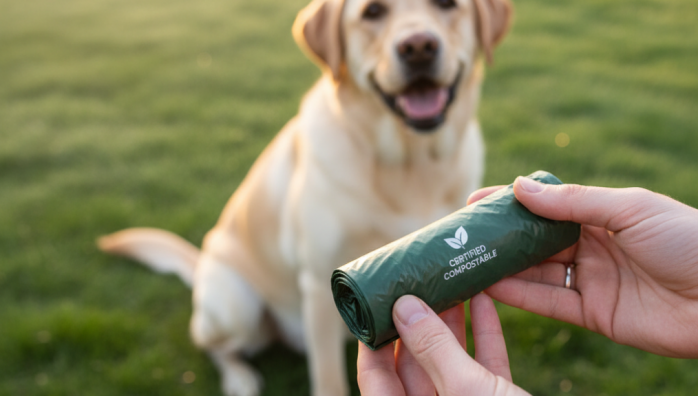
For years, I never thought twice about it. Grabbing a plastic poop bag before a walk was as automatic as clipping on the leash. But one day, while looking at the overflowing bin of just dog waste bags, it hit me. I was creating a small mountain of single-use plastic every single year. As someone who tries to be mindful about recycling and reducing waste in other areas of my life, this felt like a huge blind spot. That\'s when I decided I had to find a better, more sustainable way to handle one of the less glamorous, but most frequent, tasks of pet ownership.
My journey into the world of eco-friendly poop bags
The initial switch seemed simple: just buy \'green\' bags. But I quickly realized the market is flooded with confusing terms. Bags labeled \'eco-friendly,\' \'earth-friendly,\' and \'biodegradable\' were everywhere. For a while, I bought bags labeled \'biodegradable,\' thinking I was making a great choice. I later learned that the term can be incredibly misleading. Many of these bags are still plastic, just with additives that help them break down into smaller and smaller pieces of plastic, or microplastics, which can be even more harmful to the environment. It was a classic case of \'greenwashing,\' and I felt a bit duped.
The crucial difference: biodegradable vs. compostable
This is the \'aha\' moment I wish I\'d had sooner. The key difference lies in how the materials break down. A truly compostable bag is made from plant-based materials, like cornstarch, and is designed to break down completely into natural elements (humus, water, and CO2) in a composting environment. It becomes part of the soil again. Biodegradable, as I mentioned, is a vague term with no regulated standard in many places. It doesn\'t guarantee the product will break down completely or in a timely manner, especially in a landfill environment where there\'s no oxygen.
What i learned to look for
To make sure I was getting the real deal, I started looking for specific certifications on the packaging. For those of us in the US, the key one is ASTM D6400. In Europe, it\'s EN 13432. Seeing one of these logos gave me confidence that the bag would actually break down as promised in a commercial composting facility.
How to handle compostable bags the right way
Buying the right bag is only half the battle. You can\'t just toss dog waste into your regular backyard compost pile, even with a compostable bag. Dog and cat waste contain pathogens that can be harmful to humans, and a typical home compost pile doesn\'t get hot enough to kill them. Using that compost on a vegetable garden would be a serious health risk.
So, what\'s the solution? Some cities have industrial composting facilities that accept pet waste, so it\'s always worth checking with your local municipality. Another option is to set up a separate, dedicated pet waste composting system in your yard, far away from any edible plants. If neither of those is an option, I\'ve come to terms with the fact that even if a compostable bag ends up in a landfill, I\'m still choosing a plant-based product over a petroleum-based plastic one, which feels like a step in the right direction.
It\'s about small steps and big impacts
Switching to certified compostable poop bags was a small, easy change in my daily routine, but it has a big impact on my peace of mind. It’s one less source of plastic guilt in my life and a simple way to align my daily actions with my desire to be a more responsible, eco-conscious pet parent. It\'s not about being perfect, but about making better choices where we can.