Understanding Procrastination and Self-Discipline
by admin in Productivity & Tools 143 - Last Update November 21, 2025
For years, I treated procrastination and self-discipline as two opposing armies fighting inside my head. On good days, the discipline army would win, and I’d feel accomplished. On most days, however, the procrastination army would overwhelm my defenses, leaving me in a cycle of avoidance and guilt. It felt like a constant battle of willpower, and frankly, I was losing. The real shift for me didn\'t come from finding a magical productivity app or a new to-do list method; it came from fundamentally misunderstanding what I was fighting against.
The real reason we procrastinate (it\'s not what you think)
I used to believe procrastination was a simple character flaw: laziness. But after years of struggling, I\'ve come to see it differently. It\'s not a time management problem; it\'s an emotion management problem. I realized I was procrastinating on tasks not because they were hard, but because they made me feel something I didn\'t want to feel—boredom, frustration, anxiety, or self-doubt. The act of putting it off was a short-term mood booster. My brain was choosing immediate relief over long-term gain. Recognizing this was a huge \'aha\' moment. It stopped being about shaming myself for being \'lazy\' and started being about asking, \'What feeling am I trying to avoid right now?\'
Self-discipline isn\'t about brute force
My old view of self-discipline was a grim-faced drill sergeant yelling at me to \'just do it.\' I tried to force my way through tasks using sheer willpower, and it almost always led to burnout. I now believe that true, sustainable self-discipline is much quieter and kinder. It\'s not about having more willpower; it\'s about creating a structure where you need less of it. It’s a skill, not a superpower, and like any skill, it\'s built through small, consistent practice.
My \'two-minute\' rule breakthrough
One of the most practical shifts I made was adopting the \'two-minute rule.\' The idea is simple: if a task takes less than two minutes, do it immediately. For larger tasks, the rule is to just start and work for only two minutes. I can\'t tell you how many times I told myself, \'Okay, I\'ll just open the document and write one sentence.\' Two minutes felt so manageable that my brain didn\'t put up its usual fight. More often than not, those two minutes would turn into ten, then thirty. The hardest part is starting, and this little trick bypasses that initial emotional hurdle.
Creating a \'choice architecture\' for success
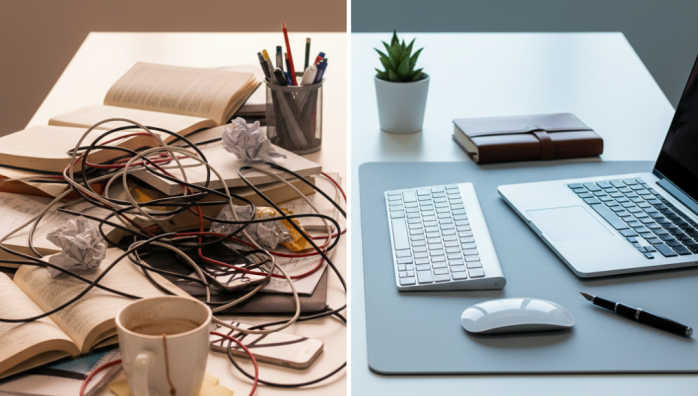
I also realized I was making procrastination too easy for myself. My phone was always within reach, distracting websites were a click away, and my workspace was a mess. So, I started redesigning my environment. I\'d put my phone in another room when I needed to focus. I used a browser extension to block distracting sites during work hours. I organized my desk so that everything I needed for my main task was right there. I was building a \'choice architecture\' where the disciplined choice was the path of least resistance. It wasn\'t about fighting temptation anymore; it was about removing it in the first place.
Embracing the nuance
Finally, I\'ve learned to be less black-and-white about it. Procrastination is a fundamental part of being human. Instead of trying to eliminate it completely, I\'ve learned to work with it. I now recognize the difference between destructive procrastination (scrolling social media) and productive procrastination (clearing my inbox when I can\'t face writing a report). Sometimes, giving myself permission to do a smaller, easier task can build the momentum I need to tackle the bigger one. It\'s a dance, not a war. Understanding the underlying psychology has allowed me to lead, rather than just be dragged along.