Recognizing Pet Choking Hazards
by admin in Pet Care Basics 113 - Last Update November 27, 2025
I\'ll never forget the silence. One minute, my beagle, Cooper, was happily gnawing on a new chew toy. The next, there was just this awful, quiet panic in his eyes. He was pawing at his mouth, and I realized a piece had broken off and gotten lodged in his throat. That terrifying moment, which thankfully ended okay after a frantic vet visit, completely changed how I look at my home. It\'s not just a space we share; it\'s an environment I have to actively manage for safety. Recognizing choking hazards isn\'t about being paranoid; it\'s about being prepared, and it’s a lesson I learned the hard way.
Common household items that pose a risk
After that incident with Cooper, I did a full audit of my home, and I was shocked at what I found. It’s often the things we don’t even think about. Things like children\'s small toys, rubber bands, hair ties, and even socks can be incredibly dangerous if ingested. For cats, I\'ve learned that string, yarn, and tinsel are particularly hazardous because they can cause linear foreign body obstructions, which are a serious medical emergency. I now have a \'pet-safe\' zone for anything smaller than a golf ball and I\'m meticulous about keeping craft supplies and office items securely put away.
The danger of \'pet-safe\' toys
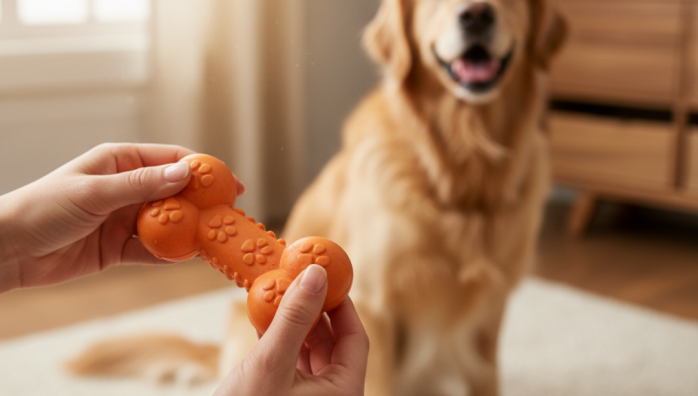
Here’s the thing that really surprised me: even items designed for pets can be a problem. That chew toy Cooper choked on was marketed as \'indestructible\'. I\'ve since learned that no toy is truly 100% safe. It\'s about supervising your pet and understanding their chew style. I now follow a simple rule: if a toy can fit entirely in my dog\'s mouth, it\'s too small. I also regularly inspect toys for wear and tear, and the second I see cracks or pieces breaking off, the toy goes in the trash. It’s a small habit that brings me immense peace of mind. Of course, I always recommend chatting with your vet about the best types of toys for your specific pet\'s breed and chew strength.
Food hazards you might be overlooking
We all know about chocolate and grapes, but some choking hazards are purely mechanical. Cooked bones are a huge one; they can splinter easily and cause choking or internal damage. I learned this from my vet after asking if I could give my dog leftover chicken bones. The answer was a firm \'no\'. Other risky foods include things like corn on the cob, fruit pits (from peaches or avocados), and even large, hard chunks of kibble for smaller pets. I now make a point of cutting up any large treats and I always supervise meal times, just in case.
What to watch for: signs of choking
The signs aren\'t always as dramatic as you see in movies. From my experience and training, I\'ve learned to watch for more subtle cues. These can include:
- Pawing at the mouth or face
- Distress and panicked behavior
- Excessive drooling
- Coughing that is weak or unproductive
- A bluish tint to the gums or tongue (this is a critical emergency)
Knowing these signs is the first step. The second is knowing what to do. I strongly encourage every pet owner to take a pet first aid and CPR class. It’s an investment that could one day save your best friend\'s life. Being prepared has replaced my fear with confidence, and that\'s a feeling every pet parent deserves.