Combating procrastination with small achievable steps
by admin in Productivity & Tools 140 - Last Update November 23, 2025
I used to be a master of procrastination. I\'d have a huge, important project on my plate, and I\'d do anything to avoid it: organize my desktop, deep-clean the kitchen, suddenly develop an interest in 18th-century naval history. The task felt like a mountain, and the thought of climbing it was so overwhelming that I couldn\'t even bring myself to take the first step. It was a cycle of anxiety, avoidance, and guilt. The turning point for me wasn\'t some complex productivity system, but a ridiculously simple shift in perspective: focusing on the power of small, almost laughably achievable steps.
The psychological paralysis of the \'big picture\'
For years, I thought that keeping my eyes on the prize was the key to motivation. I\'d visualize the finished project, the successful outcome. But I\'ve come to realize this was actually part of the problem. My brain, like most people\'s, is wired for immediate gratification. When the reward (a completed project) is weeks or months away, but the effort is required right now, the disconnect is huge. That gap is where procrastination thrives. Staring at the summit of the mountain doesn\'t help you climb; it just reminds you how far you have to go. It felt less like inspiration and more like a recipe for despair.
My \'so small you can\'t say no\' rule
My breakthrough came when I decided to stop trying to motivate myself to do the whole task. Instead, I started asking a different question: What is the absolute smallest action I can take right now that moves me forward, even by a millimeter? I\'m not just talking about breaking a task down; I\'m talking about shrinking the first step until it feels trivial.
- Instead of \'write a report,\' my first step became \'open a new document and type a title.\'
- Instead of \'clean the garage,\' it was \'put one tool back where it belongs.\'
- Instead of \'go for a run,\' it was \'put on my running shoes.\'
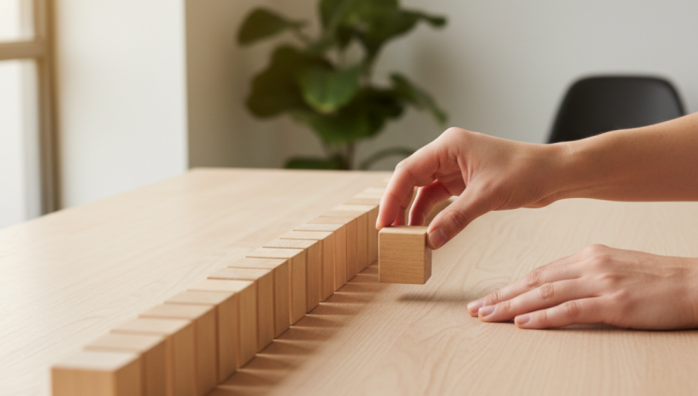
Honestly, it felt silly at first. But something magical happened. Once I had the document open, typing a few sentences seemed easy. Once I was in the garage, I\'d see another thing to put away. Once my shoes were on, walking out the door was the natural next step. I wasn\'t trying to build a wall; I was just laying a single brick.
How I build momentum with micro-tasks
This isn\'t about just having a long to-do list. It\'s a strategic approach to managing my own psychology. Over time, I\'ve refined my process into a few core principles that I follow consistently.
I define the \'very next physical action\'
Vague tasks are a killer. \'Work on project\' is a recipe for disaster. I force myself to be specific. What is the next physical thing I need to do? Is it \'pick up the phone and dial this number\'? Is it \'open my email client and type this specific subject line\'? This removes all ambiguity and the mental energy required to figure out where to start.
I create \'chains\' of small steps
Once I get one small step done, I immediately identify the next one. This creates a chain reaction. The satisfaction from completing one tiny task provides the little burst of dopamine needed to tackle the next. It\'s like a snowball rolling downhill. The initial push is tiny, but the momentum it builds becomes a powerful force. This has been the most effective way for me to turn 5 minutes of work into an hour of focused, productive time without even noticing.
The surprising long-term benefit: rebuilding trust with myself
The most profound change wasn\'t just getting more done. It was that I slowly started to rebuild trust in my own ability to follow through. Every time I completed a tiny task I set out to do, it was a small promise I kept to myself. Over weeks and months, these small wins accumulated, quieting the anxious voice that used to tell me I\'d never finish anything. Combating procrastination wasn\'t about finding a magic bullet; it was about learning to walk again, one small, deliberate, and achievable step at a time.