Biodegradable Waste Bags for Pet Owners
by admin in Pet Care Basics 131 - Last Update November 28, 2025
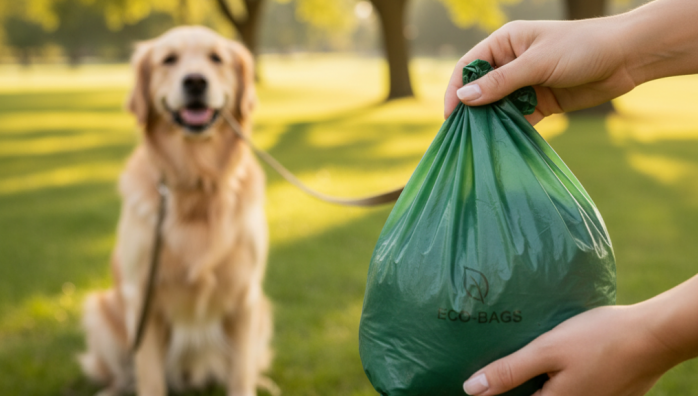
For years, the routine was the same. Leash on, door open, and a roll of plastic bags stuffed in my pocket. It was an automatic, unthinking part of every walk. But one day, I paused and actually looked at the little plastic knot in my hand. It struck me that I was creating one of these, twice a day, every single day. The sheer volume of plastic I was personally sending to a landfill, just from my one beloved dog, suddenly felt enormous. That was the moment I knew I had to find a better way.
The plastic problem I couldn\'t ignore anymore
When you start thinking about it, the numbers are staggering. Millions of pet owners, using multiple plastic bags daily. It\'s a mountain of waste. I started doing some research, and honestly, it was a bit overwhelming. I just wanted a simple, eco-friendly swap, but I was suddenly swimming in terms like \'degradable\', \'biodegradable\', and \'compostable\'. I realized that just grabbing a box with a green leaf on it wasn\'t enough; I needed to understand what I was actually buying.
What \'biodegradable\' really means for pet waste
The journey down the rabbit hole of eco-friendly plastics was eye-opening. What I learned is that not all \'green\' bags are created equal. In fact, some can be just as problematic as traditional plastic if you don\'t know what you\'re looking for. It took a bit of effort, but figuring out the key differences gave me the confidence to make a truly sustainable choice.
Biodegradable vs. compostable: my biggest confusion
Initially, I used these terms interchangeably, but they are critically different. A truly biodegradable bag is made from materials (often plant-based, like cornstarch) that can be broken down by microorganisms into natural elements like water, CO2, and biomass. Compostable bags are a subset of this; they also break down into natural elements, but they do so within a specific timeframe and under specific conditions (usually an industrial composting facility) to create nutrient-rich humus. Most home compost piles don\'t get hot enough to break down certified compostable pet waste bags safely.
A word of caution about \'degradable\' bags
This was my biggest \'aha\' moment. I discovered that many cheap bags labeled as \'degradable\' or \'oxo-degradable\' are made from regular plastic with additives that cause them to break apart into tiny pieces when exposed to sunlight and air. They don\'t disappear; they just become microplastics, which can be even more harmful to the environment. I made a firm decision to avoid these entirely once I understood that.
How I choose the right biodegradable bags now
After all my reading, I developed a simple checklist for choosing bags. It\'s not about finding one perfect brand, but about knowing what to look for on any package. It’s made my shopping trips so much faster and I feel much better about my purchase.
- Check for certifications: I learned to look for official certifications that prove a product meets specific standards. In the US, that\'s often ASTM D6400, and in Europe, it\'s EN 13432. These confirm the bags are truly compostable in industrial facilities.
- Look at the material: I personally lean towards bags made from 100% plant-based materials like cornstarch (PLA) and PBAT. They feel different—softer and silkier—but are surprisingly strong.
- Test for durability: Nothing is worse than a bag failure on a walk! I always opt for bags that feel thick and have good reviews regarding their strength and leak-proof seams. A cheap bag isn\'t worth the mess.
- Consider your local disposal options: This is key. If you don\'t have access to industrial composting that accepts pet waste, a home-compostable certified bag might be an option, but it\'s crucial to check if pet waste is safe for your garden compost (most experts say no due to pathogens). For most of us, a truly biodegradable bag that breaks down more effectively in a landfill environment is still a huge step up from traditional plastic.
Making the switch was a small change in my daily routine, but it represented a big shift in my mindset as a pet parent. It’s one less piece of single-use plastic, and one more step toward being the responsible, caring owner I always strive to be. It just feels right.