Batching Content Production for Creative Workflow
by admin in Productivity & Tools 144 - Last Update December 5, 2025
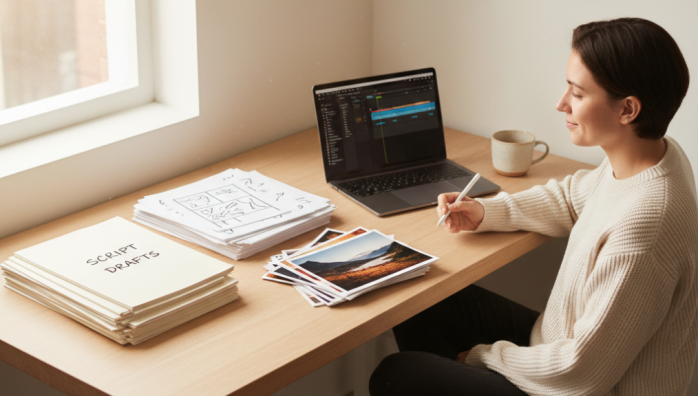
I remember the exact moment I thought about quitting. I was staring at a blinking cursor on a blank page, my calendar screaming with a dozen different \'to-dos\' for three different platforms. I was a writer, a video editor, a social media manager, and a strategist all before my first cup of coffee. The constant context-switching wasn\'t just unproductive; it was actively destroying my creativity. That\'s when I stopped working *harder* and started working *smarter* by embracing content batching. It didn\'t just change my workflow; it saved my sanity.
What is content batching, really?
Forget the textbook definitions. For me, content batching is simply a commitment to focus. It\'s the practice of grouping all similar tasks together and executing them in a single, dedicated time block. Instead of writing one blog post, then filming a video, then designing a graphic, I now dedicate separate days or blocks of time to *only* writing, *only* filming, or *only* designing. It’s about getting into a specific mental \'zone\' and staying there, leveraging momentum instead of constantly starting and stopping.
Why my old \'one-off\' method failed me
For years, I operated on a \'one-and-done\' basis. I’d complete a piece of content from idea to publication before starting the next. Honestly, it felt productive at first, like I was checking things off a list. But I eventually realized a few things. First, the mental startup cost for each task was huge. The gear-shifting from research mode to writing mode to editing mode was exhausting. Second, my quality was inconsistent. On a low-energy day, the entire piece of content suffered. Finally, I lived in a constant state of low-grade panic, always chasing the next deadline. There was no room for error, and certainly no room for a sick day.
My step-by-step batching workflow
After a lot of trial and error, I landed on a four-stage process that brings order to my creative chaos. It’s flexible, but the principle of separation is key.
Step 1: The brain dump and idea phase
I set aside one block of time per month just for ideas. I don’t judge them, I don’t outline them, I just get them out. I use a simple note-taking app to capture everything from a single headline to a full-blown concept. This is a low-pressure, purely creative session that fuels the entire production line.
Step 2: The research and outlining block
Once my ideas are chosen for the upcoming weeks, I schedule a separate block for research and outlining. Here, I\'m a detective. I gather stats, find sources, and structure my arguments for all my planned articles or videos at once. By the end of this session, I have a collection of solid \'skeletons\' ready for the next stage.
Step 3: The \'creation\' zone (writing or filming)
This is the most energy-intensive part. I block out entire days or half-days solely for creation. If it’s a writing day, I put on my headphones and just write, moving from one outlined document to the next. I\'m not allowed to edit or second-guess myself. If it’s a filming day, I set up my equipment once and film multiple videos back-to-back. The flow state I can achieve here is something I could never find when I was task-switching.
Step 4: The editing and polishing sprint
I always edit with fresh eyes, at least a day after creating. This separation is critical. I schedule a block for editing all the articles I wrote or all the videos I filmed. In this phase, I\'m ruthless and analytical, a mindset that’s completely different from the creative flow state. Batching my edits ensures consistency in quality and tone across my content.
The tools that make it possible for me
You don’t need a fancy, expensive suite of tools. My system runs on three simple things: a digital calendar to time-block my batching sessions, a task manager to list the specific pieces of content for each block, and a cloud-based document app for my outlines and drafts. The technology just serves the method; it doesn\'t define it.
My final thoughts on creative freedom
I initially resisted batching because I thought it sounded too rigid and industrial for a creative process. I was wrong. By creating structure and handling the logistical parts of content creation in an efficient way, I’ve actually freed up more mental space for what matters: the creative spark itself. I no longer dread the blinking cursor. I have a plan, and that plan gives me freedom.