Basic Pet Choking First Aid Steps
by admin in Pet Care Basics 138 - Last Update November 27, 2025
I\'ll never forget the silence. One minute, my boisterous Labrador was gleefully crunching on a new chew toy in the living room; the next, there was a dead, terrifying quiet. His eyes went wide, and he started pawing at his mouth. It\'s a moment that freezes your blood, and it\'s precisely why I believe every single pet owner needs to have a basic choking plan in their head. It\'s not about panic; it\'s about preparation. Over my years working with animals and caring for my own, I\'ve learned that a few calm, practiced steps can make all the difference while you\'re on your way to the vet.
How to recognize the signs of choking in a pet
First, you need to know what you\'re looking for. It\'s not always a dramatic, noisy event. From my experience, the signs can be subtle at first, but they escalate quickly. Keep a sharp eye out for these red flags:
- Pawing intensely at their mouth or face.
- Gagging or retching without producing anything.
- A weak, ineffective cough or a complete inability to cough.
- Making whistling or high-pitched noises when trying to breathe.
- Their gums or tongue start to look blue or grey – this is a critical emergency.
- Obvious distress, panic, or collapsing.
If your pet is coughing forcefully, that\'s actually a good sign! It means air is still getting through. Give them space and encourage them to cough it out. My rule is to intervene only when the coughing stops or becomes weak, and the real distress begins.
The immediate steps to take for a choking pet
Okay, you\'ve identified that your pet is in true distress and can\'t breathe. Your goal is to dislodge the object while someone else is calling the emergency vet. Stay as calm as you can; your pet will feed off your energy.
Step 1: restrain and check the airway
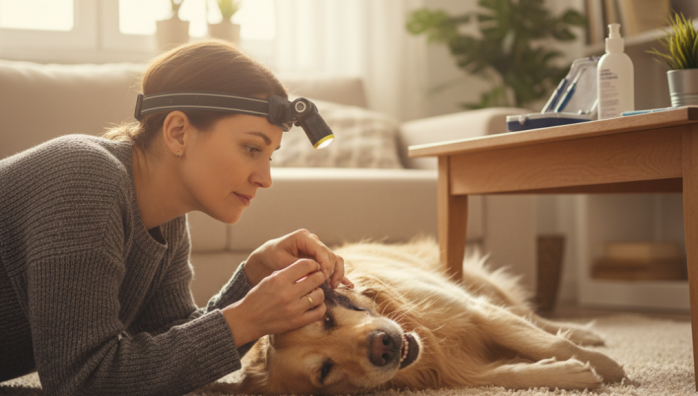
For your safety and theirs, you need to secure your pet. Gently hold them and carefully open their mouth, pointing their nose toward the ceiling. This straightens the airway. Use a flashlight if you have one handy to get a clear look. If you can see the object and it\'s easily graspable, you can attempt to remove it with your fingers or a pair of blunt-nosed tweezers. Be incredibly careful not to push it further down.
A personal note of caution: A panicking animal will bite, even if they never have before. I learned this the hard way. If you are not confident you can remove it safely, or if the animal is thrashing, do not put your fingers in their mouth. Move to the next step.
Step 2: perform back blows
If you can\'t get the object out with a sweep, the next step is to use gravity and force. Position your pet with their head pointing down. For a smaller dog or a cat, I find it\'s easiest to hold them by their hind legs like a wheelbarrow. For a larger dog, you can place them on an incline, like a staircase, with their head at the lower end. With the heel of your hand, give five firm, sharp blows between their shoulder blades. After the blows, check their mouth again.
Step 3: use abdominal thrusts (the pet heimlich)
If back blows don\'t work, you\'ll need to perform abdominal thrusts. The technique varies slightly by size.
- For small dogs and cats: Kneel on the floor and hold your pet on your lap, with their back against your stomach. Find the soft spot just behind their ribs. Make a fist with one hand, cover it with the other, and give five quick, upward thrusts.
- For large dogs: If the dog is standing, wrap your arms around their body, joining your hands just behind their rib cage. Make a fist and give five quick, upward and forward thrusts. If the dog is lying down, place one hand on their back for support and use your other hand to push on the abdomen.
After each set of five thrusts, check the mouth for the object. Continue this process while you are getting to an emergency veterinary clinic. These steps are a bridge to professional help, not a replacement for it. Even if you dislodge the object, it\'s crucial to have a vet check for internal injuries or throat damage. This is just my experience, and I always, always recommend following up with your vet after any emergency situation.