Basic Canine CPR Steps
by admin in Pet Care Basics 260 - Last Update November 30, 2025
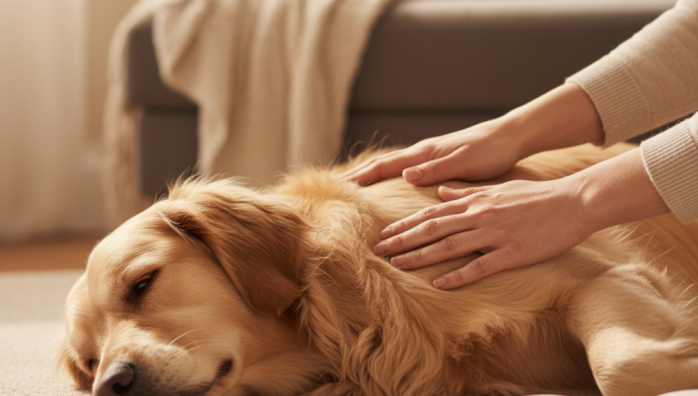
I\'ll never forget the moment I realized I was completely unprepared. My friend\'s older dog choked on a treat, and for a few terrifying seconds, nobody knew what to do. Thankfully, he coughed it up, but it was a massive wake-up call for me. It\'s a skill you pray you\'ll never need, but knowing the basics of canine CPR gave me a sense of peace and preparedness I didn\'t have before. It’s not just for vets; it’s for any of us who love a dog.
Before you start: The \'dr. abc\' of pet emergencies
Before you ever start CPR, you need to assess the situation. I learned the simple mnemonic \'Dr. ABC\' to keep a clear head. It stands for Danger, Response, Airway, Breathing, and Circulation.
- Danger: First, make sure the area is safe for both you and the dog. Look for traffic, electrical wires, or anything that could cause further harm.
- Response: Check if your dog is responsive. Gently tap them and call their name. If there\'s no response, they are unconscious.
- Airway: Carefully open their mouth, pull the tongue forward, and look for any obstruction. If you see something, carefully try to remove it.
- Breathing: Look for the rise and fall of the chest. Hold your hand or cheek near their nostrils to feel for breath.
- Circulation: Check for a pulse. The easiest place to find it is on the inside of the back leg, high up where the leg joins the body (the femoral artery).
CPR should only be started if the dog is unconscious, not breathing, and has no pulse.
The core cpr steps: Compressions and breaths
Once you\'ve determined CPR is necessary, the goal is to manually pump the heart and breathe for your dog. It\'s a two-part process that you\'ll cycle through. Of course, the absolute priority is to have someone else call an emergency vet while you begin.
Chest compressions
The technique changes slightly based on your dog\'s size. For most medium-to-large dogs, have them lie on their right side. Place the heel of one hand over the widest part of their chest, put your other hand on top, and lock your elbows. For barrel-chested dogs like Bulldogs, you may need to have them on their back. For very small dogs, you can often just use one hand to encircle their chest and squeeze. You should aim for a rate of 100-120 compressions per minute. A helpful trick I was taught is to push to the beat of the song \"Stayin\' Alive.\" You want to compress the chest to about one-third to one-half of its normal depth.
Rescue breaths
For rescue breaths, you perform mouth-to-snout resuscitation. Gently close your dog\'s mouth and hold it shut with your hands. Place your mouth completely over their nostrils and give two breaths, just long enough to see their chest rise. Don\'t breathe too forcefully, especially with smaller dogs.
Putting it all together: The 30:2 ratio
The standard cycle is 30 chest compressions followed by 2 rescue breaths. You repeat this cycle continuously. Honestly, it\'s physically exhausting, which is why if someone else is there, it\'s a good idea to switch off every couple of minutes to maintain the quality of the compressions. Continue this cycle until your dog starts breathing on their own, or until you\'ve arrived at the veterinarian\'s office.
What i learned about being prepared
Going through this training taught me that knowing what to do is half the battle. This guide is a starting point, but I can\'t recommend enough taking a certified, hands-on pet first aid and CPR course. Practicing on a manikin makes all the difference. This is just my experience and understanding, and you should always prioritize getting to an emergency vet as quickly and safely as possible.