Why I Still Use Pen and Paper in the Digital Age
by admin in Productivity & Tools 221 - Last Update November 28, 2025
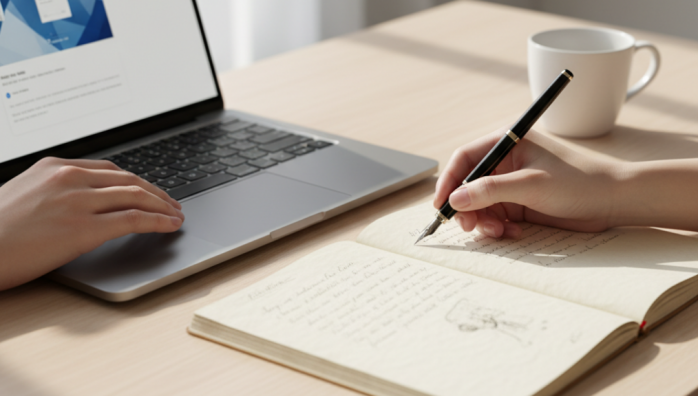
My desk often feels like a paradox. On one side, I have a high-resolution monitor, a mechanical keyboard, and a suite of the latest productivity apps humming away. On the other, a simple, dog-eared notebook and my favorite pen. For years, I tried to go fully digital. I chased the dream of a single, unified system, but I always came back to paper. And I’ve finally stopped feeling guilty about it.
The friction I actually need
Digital tools are designed to be frictionless. You can type, delete, and rearrange thoughts with blinding speed. But I discovered that this very lack of friction was a problem for my thinking. When I write by hand, I\'m forced to slow down. The physical act of forming letters on a page connects my brain to the ideas in a way that typing on a keyboard never has. It\'s a deliberate, almost meditative process. I found my best ideas didn\'t come from a flurry of keystrokes, but from the slow, intentional scratch of a pen on paper.
A sanctuary from the digital noise
Let\'s be honest: opening a laptop is an invitation for distraction. A tab is just a click away, a notification is always waiting to pop up. When I open my notebook, there\'s nothing else there. It’s just me and a blank page. This space is a sanctuary. It’s where I can do the deep, messy, and creative thinking without the silent pull of my email inbox or a social media feed. It\'s my dedicated space for focus, and that has become invaluable in a world designed to steal our attention.
How I created my hybrid system
This isn\'t an argument to abandon your digital tools. I certainly haven\'t. My breakthrough came when I stopped seeing it as an \'either/or\' choice and started building a \'both/and\' system. It’s surprisingly simple:
- Capture & Brainstorming (Analog): All my raw ideas, daily to-do lists, and mind maps start in the notebook. It’s messy, non-linear, and completely private.
- Structure & Action (Digital): Once an idea has been fleshed out on paper, I move the refined, actionable parts into my digital system. A project plan goes into my task manager. A well-formed thought goes into my digital knowledge base.
This process acts as a natural filter. Only the most important ideas survive the migration from analog to digital. It keeps my digital workspace clean and focused on execution, while my notebook remains the space for unbounded creativity.
It\'s about the right tool for the job
After years of chasing the perfect all-in-one app, I’ve made peace with the fact that it doesn’t exist for me. Some tasks benefit from the power and connectivity of digital tools, while others require the focused, tactile nature of pen and paper. Accepting this duality has not only improved my productivity but also made my work more enjoyable. My notebook isn’t a relic of a bygone era; it\'s the most essential, modern tool on my desk.