Why I Still Use Pen and Paper in the Age of Digital Notetaking
by admin in Productivity & Tools 153 - Last Update November 20, 2025
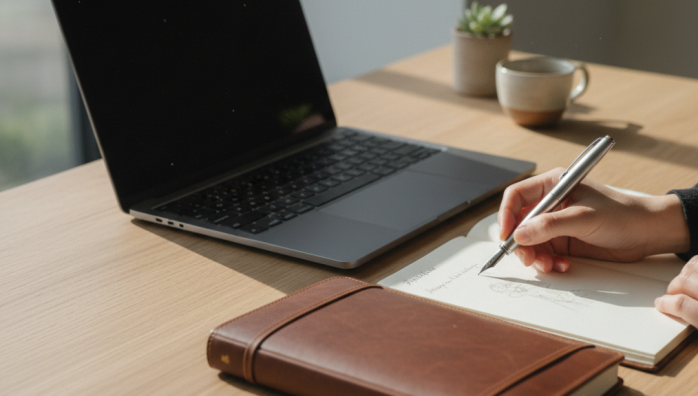
I\'ve tried them all. The minimalist markdown editors, the complex second-brain apps with back-linking and graph views, the synced-across-all-devices platforms. For years, I was convinced that the perfect digital system was the key to unlocking my productivity. And yet, I found myself spending more time managing my notes than actually thinking. It was a subtle, creeping exhaustion that I couldn\'t quite put my finger on until I found myself in a meeting with a dead laptop and a simple, forgotten notepad in my bag.
The digital promise and the analog reality
The allure of digital is powerful. Infinite canvases, perfect searchability, cloud backups—it promises a world where no idea is ever lost. I built intricate systems with tags, folders, and links. My digital workspace was a testament to organization. But in practice, it felt brittle. The constant pull of notifications, the temptation to check just one more thing, and the friction of opening an app just to jot down a fleeting thought often meant the thought was gone before I captured it.
My \'aha\' moment with a simple notebook
In that meeting with my dead laptop, I reluctantly opened that dusty notebook. As I started scribbling with a basic pen, something shifted. There were no formatting options to distract me. No hyperlinks to chase. It was just me, the paper, and my thoughts. The connection felt immediate and visceral. I wasn\'t just transcribing; I was thinking *through* the pen. I could sketch, connect ideas with arrows, and underline things with a satisfying physicality that no app could replicate. That was the moment I realized I had been optimizing for the wrong thing. I was optimizing for storage, not for thinking.
How I blend analog and digital today
I didn\'t abandon my digital tools. That would be just as extreme as my previous all-in approach. Instead, I developed a hybrid system that leverages the strengths of both worlds. It\'s a system born from my own experience and experimentation, and it\'s what has worked wonders for my focus.
- Analog for ideation and daily planning: Every morning, I plan my day in a physical planner. All my brainstorming, mind-mapping, and initial drafting happens on paper. This is my sacred, distraction-free thinking space.
- Digital for archiving and retrieval: Once an idea is fleshed out or a project plan is finalized, I transfer the key points into my digital system. It becomes my searchable archive, my long-term storage. I don\'t transfer every doodle; only the refined output. This intentional friction ensures only valuable information makes the cut.
The power of tactile thinking
I\'ve come to believe deeply in the power of tactile thinking. The physical act of writing forces me to slow down and be more deliberate. Studies suggest that writing by hand activates different parts of the brain than typing, often leading to better memory and comprehension. I can\'t cite the specific studies, but I can tell you from personal experience: I remember the things I write down far better than the things I type.
Is this a step backward?
Some might see returning to paper as a regression. I see it as a strategic advance. It\'s about consciously choosing the right tool for the job, not just defaulting to the most technologically advanced one. In an age of digital saturation, the greatest luxury is focus. And for me, that focus often begins with the simple, humble, and incredibly powerful combination of pen and paper.